
Empowering Business Transformation: Check out our Technology and AI Readiness solutions Learn More

Organizational transformation consulting

The Executive Guide to AI Readiness Banner | Soltec
AI Readiness, Soltec

The Executive Guide to AI Readiness

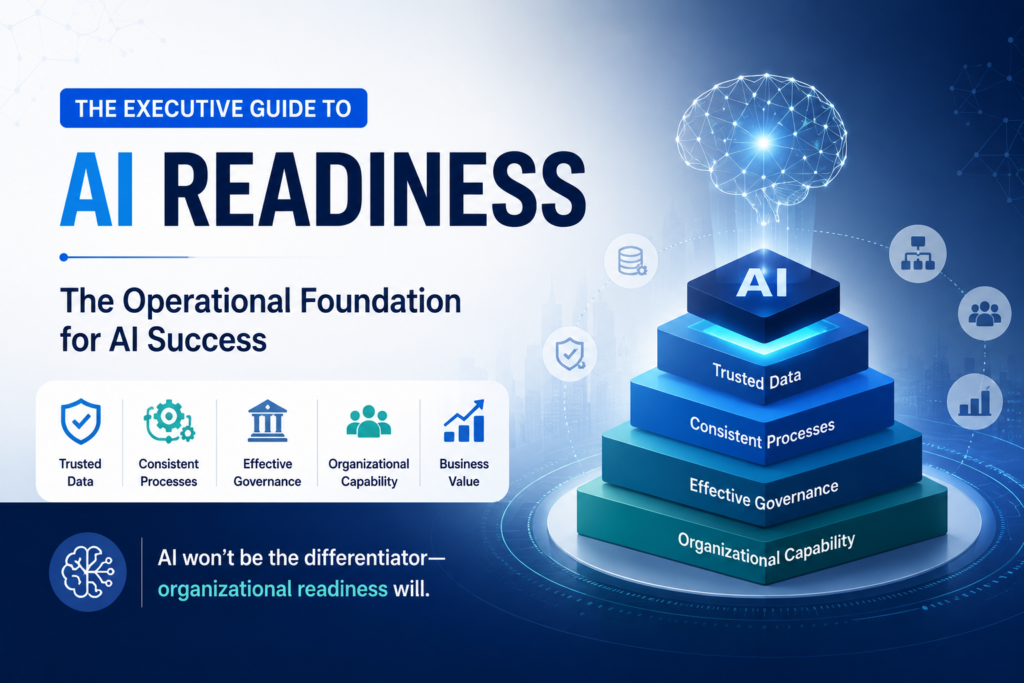
Artificial Intelligence (AI) won’t be the differentiator—organizational readiness will. AI has become an executive priority across nearly every industry. Yet successful AI adoption depends on far more than selecting the right technology. Organizations that prepare their operational foundations as intentionally as they prepare their AI strategy are better positioned to achieve lasting business value. What Is AI Readiness? AI Readiness was never determined by the technology an organization selects. It has always been determined by the organization AI is asked to support. AI Readiness is an organization’s ability to successfully adopt, govern, and scale AI by establishing the operational foundations required for consistent, reliable, and trusted outcomes. While many organizations approach AI as a technology initiative, AI Readiness extends well beyond selecting AI platforms or deploying new tools. It reflects how prepared the enterprise is to support AI through trusted data, consistent business processes, effective governance, integrated technology, organizational capability, and a clear strategy for creating business value. Organizations that are AI-ready recognize that AI can only perform as effectively as the environment in which it operates. When workflows are inconsistent, business rules are applied differently across the enterprise, or data lacks quality and trust, AI will often amplify those weaknesses rather than overcome them. This is why AI Readiness should be viewed as a business discipline rather than simply a technology initiative. It helps executive leaders evaluate whether the enterprise is prepared to support AI successfully before making additional technology investments, reducing implementation risk while increasing the likelihood of achieving meaningful business outcomes. Why AI Readiness Has Become an Executive Priority Although the operational foundations of AI Readiness have always existed, the business environment surrounding them has changed dramatically. Artificial intelligence has become a strategic capability that is reshaping how organizations operate, make decisions, and create value.  As investment has accelerated, so have executive expectations. Organizations are no longer asking whether AI will influence their business. They are asking how quickly they can adopt it and where it can deliver the greatest value. Research Insight McKinsey’s 2025 State of AI survey found that AI adoption has become widespread across enterprises, yet organizations creating measurable business value are the ones redesigning workflows, strengthening governance, and making organizational changes alongside technology deployment. The research reinforces that successful AI adoption depends on organizational readiness—not technology implementation alone. – McKinsey & Company, The State of AI: Global Survey (2025) What has changed is not simply the technology. The game has changed. For decades, organizations could often improve business performance by implementing new enterprise applications, modernizing existing systems, or automating individual processes. AI operates differently. Rather than following predefined rules, AI depends on the quality of the operational environment it enters. It learns from enterprise information, supports business decisions, and increasingly becomes part of how work is performed. As a result, AI reflects the operational maturity of the organization itself. It cannot consistently compensate for fragmented workflows, inconsistent business rules, disconnected systems, or data that lacks quality and trust. Instead, it often exposes those challenges while accelerating their impact across the enterprise. This shift requires executives to think differently about AI investment. The first question should no longer be, “Which AI solution should we implement?” It should be, “Is our organization prepared to support AI successfully?” That question represents the beginning of AI Readiness. Why So Many AI Initiatives Fall Short Previous generations of enterprise technology could often deliver meaningful business value despite operational immaturity. Organizations successfully implemented ERP systems, CRM platforms, workflow automation, analytics, and other enterprise technologies while continuing to rely on disconnected systems, inconsistent processes, manual workarounds, spreadsheet dependencies, and data that was less than ideal. AI changes that equation. Unlike traditional enterprise applications, AI increasingly depends upon the quality of the operational environment in which it operates. It learns from enterprise information, participates in business processes, and influences decisions across the organization. As a result, weaknesses that organizations were once able to compensate for through human judgment and experience become significantly more difficult to overcome. Many organizations continue to approach AI as another technology implementation rather than recognizing it as an organizational capability. They evaluate AI platforms before evaluating operational readiness, often assuming AI will compensate for inconsistent processes, fragmented workflows, disconnected systems, or poor data quality. In reality, AI is more likely to expose those weaknesses than eliminate them. Research Insight McKinsey’s global AI research continues to show that while AI adoption is becoming nearly universal, only a minority of organizations have successfully scaled AI across the enterprise and achieved significant financial impact. The difference is increasingly tied to workflow redesign, governance, organizational change, and operational integration—not simply deploying additional AI tools. McKinsey & Company, The State of AI: Global Survey (2025) This explains why organizations with significant technology investments may still struggle to achieve meaningful business outcomes from AI. The challenge is rarely the AI technology itself. More often, organizations have not established the operational foundations required for AI to perform consistently and reliably at enterprise scale. AI does not create operational complexity. It reveals it. The Six Foundations of AI Readiness AI Readiness is not determined by a single capability or technology investment. It reflects how well an organization has established the operational foundations required to support AI consistently, reliably, and at enterprise scale. While every organization begins from a different starting point, successful AI adoption consistently depends upon six foundational capabilities. Weakness in any one area can limit the effectiveness of AI, regardless of the sophistication of the technology being implemented. Governance & Compliance Effective governance establishes the policies, business rules, accountability, and oversight that enable AI to operate responsibly and consistently. As AI becomes more deeply integrated into business operations, governance must extend beyond documentation and become embedded within operational execution, ensuring decisions are supported by trusted information and consistent business practices Data Quality AI depends upon accurate, complete, and trusted enterprise data. Organizations should understand where critical data originates, how it is maintained, and whether it can be relied upon to support business

Organizational Change Readiness Banner Image
AI Readiness, Soltec

Organizational Change Readiness: Preparing Your Organization For Successful Transformation

Successful organizational change begins long before communication plans, training sessions, or implementation activities. Organizations that prepare their people as intentionally as they prepare their technology are significantly better positioned to achieve lasting business outcomes. What Is Organizational Change Readiness? Organizational Change Readiness is an organization’s ability to successfully prepare its leaders, managers, employees, and operational processes to adopt and sustain new ways of working. While Organizational Change Management is often associated with communication plans, stakeholder engagement, and training, change readiness begins much earlier. It focuses on understanding how change will affect the enterprise, identifying potential barriers to adoption, developing the capabilities needed for success, and preparing the organization before implementation begins. Technology rarely creates business value on its own. People create business value by adopting new processes, embracing new ways of working, and consistently applying those changes throughout the enterprise. This is why Organizational Change Readiness should be viewed as a strategic business capability rather than simply a project activity. It helps leadership prepare the enterprise for change before the first implementation milestone is reached, reducing uncertainty, improving adoption, and increasing the likelihood of achieving the intended business outcomes. Why Do Organizations Struggle with Change? Most organizations do not struggle with change because employees resist new ideas. They struggle because leadership often underestimates the organizational effort required to successfully adopt new ways of working. Research Insight McKinsey research found that only 3% of transformation initiatives were reported as successful when line managers or frontline employees were not actively engaged throughout the transformation process. The findings reinforce that successful organizational change depends on leadership engagement and workforce involvement—not technology implementation alone. Source: McKinsey & Company, “Successful Transformations.” Technology implementations typically receive significant attention long before deployment. Project plans are developed, budgets are approved, timelines are established, and future operating models are designed. Yet many organizations spend comparatively little time understanding how those decisions will affect the people responsible for executing them every day. As a result, important assumptions are often made before leadership fully understands how work is currently performed across the enterprise. Operational complexity, undocumented processes, local workarounds, and informal business practices may not become visible until implementation is already underway, when changes become significantly more difficult—and more costly—to address. Successful organizational change begins with understanding the current state before designing the future state. When leaders invest time in understanding how work is actually performed, how responsibilities will change, and what capabilities employees will need to succeed, they create a stronger foundation for communication, training, adoption, and long-term organizational success. Organizations rarely struggle because they planned too much. More often, they struggle because they planned with an incomplete understanding of the enterprise they were asking to change. Change Readiness vs. Change Management Although the terms are often used interchangeably, Organizational Change Readiness and Organizational Change Management serve different purposes. Understanding the distinction helps organizations prepare more effectively for successful transformation. Change Readiness focuses on preparing the enterprise before implementation begins. It helps leaders understand how change will affect the organization, identify potential risks, evaluate organizational capabilities, and establish the conditions necessary for successful adoption. Change Management focuses on helping people successfully navigate the change once implementation is underway. It emphasizes communication, stakeholder engagement, training, coaching, and reinforcement to support adoption and long-term success. Organizations achieve the greatest results when both capabilities work together. Readiness establishes the foundation for change, while Change Management helps the organization successfully execute and sustain it. Organizational Change Readiness Organizational Change Management Prepares the enterprise before implementation Supports people throughout implementation Evaluates organizational readiness and capability Communicates, trains, and reinforces change Identifies risks, barriers, and organizational impacts Addresses adoption, engagement, and resistance Helps leadership understand the current state Helps employees transition to the future state Builds confidence before change begins Sustains change after implementation Organizations that focus exclusively on Change Management often discover organizational issues after implementation has already begun. Investing in Change Readiness first allows leadership to make better-informed decisions, reduce avoidable disruption, and create a stronger foundation for long-term success. What Role Does Leadership Play in Organizational Change? Leadership is the single most important factor influencing the success of organizational change. While project teams manage implementation activities, leaders establish the direction, priorities, and organizational confidence that determine whether change is ultimately embraced or resisted. Research Insight McKinsey research found that organizations where senior leaders communicate openly and consistently throughout a transformation are eight times more likely to report successful outcomes. For enterprise-wide transformations, that likelihood increases to 12.4 times when executive communication remains active throughout the initiative. Source: McKinsey & Company, “Successful Transformations.” Executive Observation Throughout my career leading large-scale organizational transformations, I found that employees rarely expected leadership to have every answer. What they wanted was confidence that leadership understood how the proposed changes would affect their work. When employees believe decisions are being made with an understanding of operational reality rather than assumptions, they are far more likely to engage with change instead of resisting it. Effective leadership during change extends beyond executive sponsorship. It requires developing a clear understanding of how the organization operates today, communicating why change is necessary, making informed decisions that reflect operational realities, and ensuring managers are prepared to lead their teams through uncertainty. Employees rarely expect leaders to have every answer. They do expect leaders to demonstrate clarity, consistency, and a genuine understanding of how proposed changes will affect the people responsible for executing them. When leadership makes decisions without fully understanding the operational impact, organizations often experience avoidable disruption, declining confidence, inconsistent adoption, and increased resistance—not because employees oppose change, but because they struggle to understand how they will succeed within it. Successful leaders invest as much effort preparing their people as they do preparing their technology. They recognize that organizational capability is built through understanding, engagement, communication, and continuous leadership long before implementation begins. Ultimately, employees do not adopt change because a project plan tells them to. They adopt change because leadership has prepared the organization to succeed. How Does Organizational Change Support

Scroll to Top