
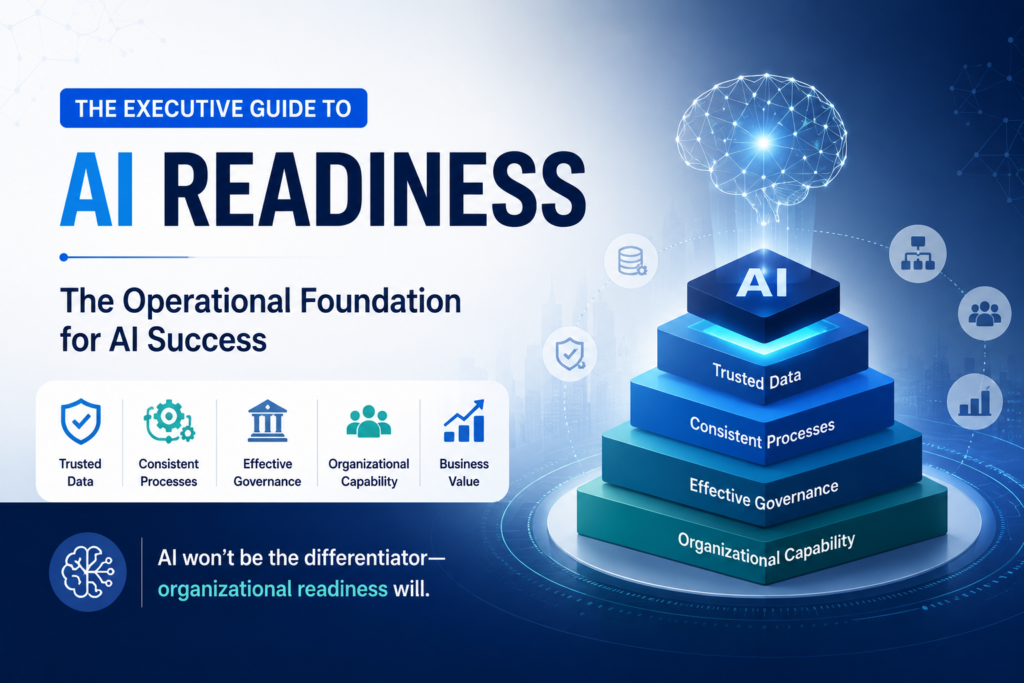
Artificial Intelligence (AI) won’t be the differentiator—organizational readiness will. AI has become an executive priority across nearly every industry. Yet successful AI adoption depends on far more than selecting the right technology. Organizations that prepare their operational foundations as intentionally as they prepare their AI strategy are better positioned to achieve lasting business value.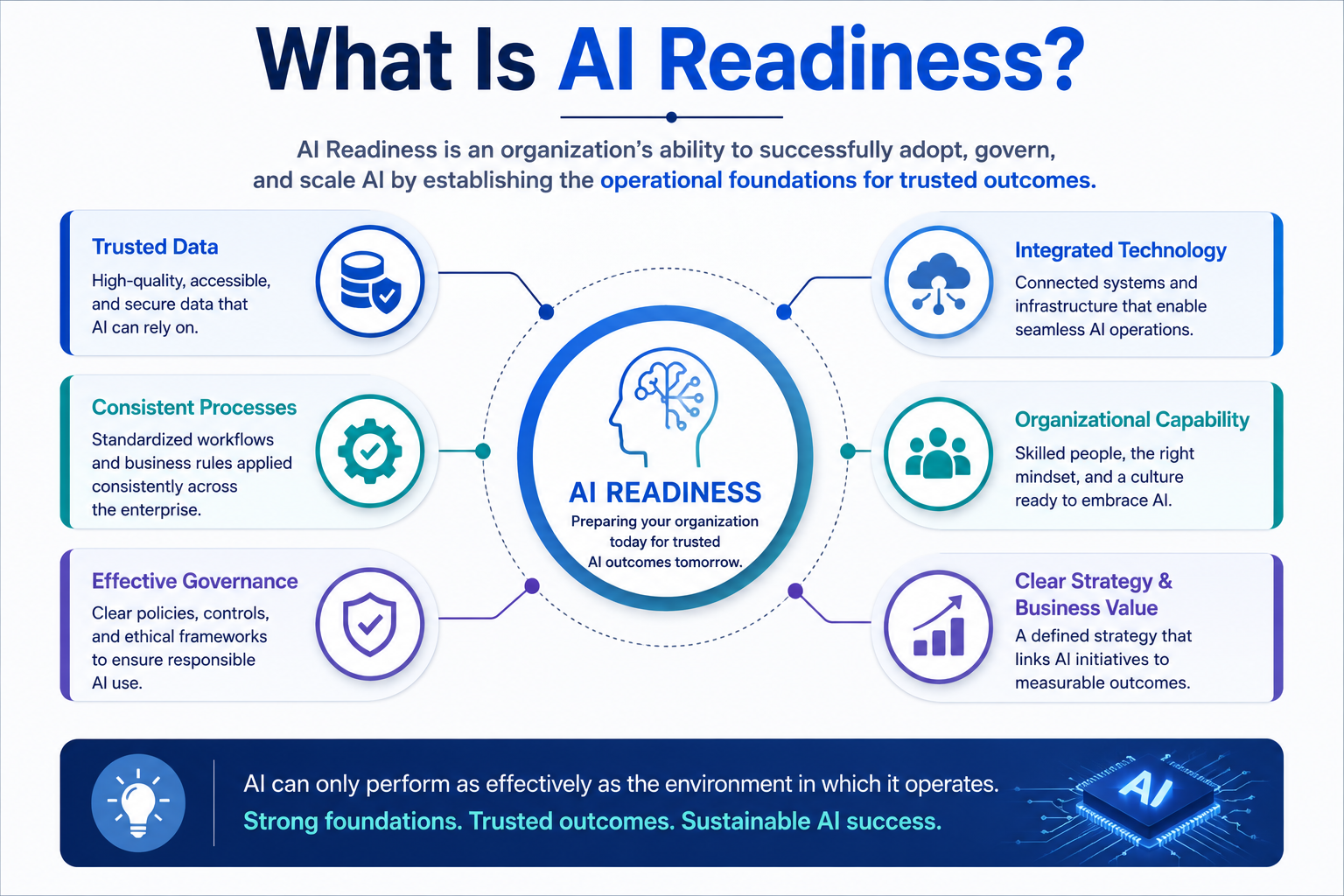 Organizations that are AI-ready recognize that AI can only perform as effectively as the environment in which it operates. When workflows are inconsistent, business rules are applied differently across the enterprise, or data lacks quality and trust, AI will often amplify those weaknesses rather than overcome them. This is why AI Readiness should be viewed as a business discipline rather than simply a technology initiative. It helps executive leaders evaluate whether the enterprise is prepared to support AI successfully before making additional technology investments, reducing implementation risk while increasing the likelihood of achieving meaningful business outcomes.
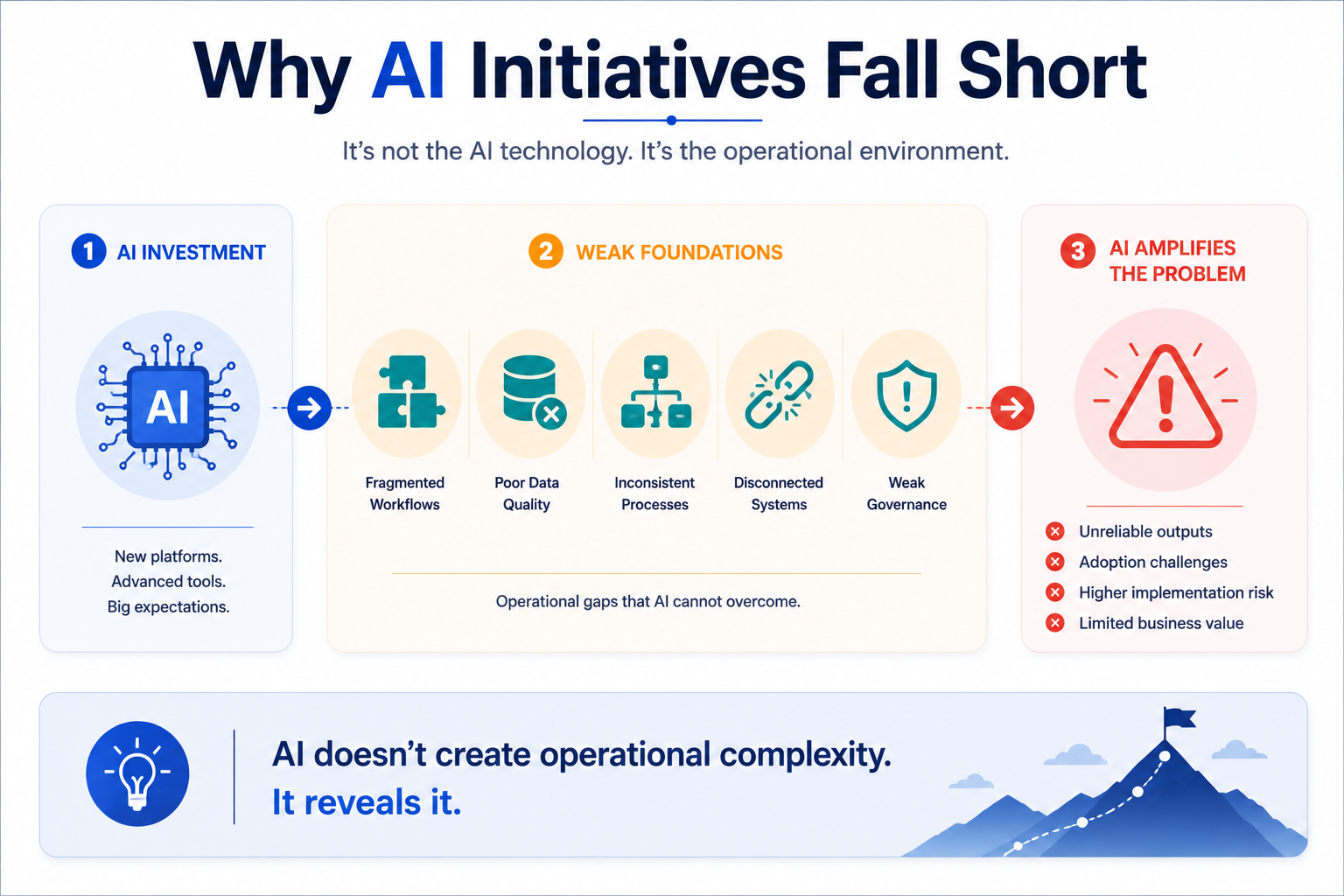 Many organizations continue to approach AI as another technology implementation rather than recognizing it as an organizational capability. They evaluate AI platforms before evaluating operational readiness, often assuming AI will compensate for inconsistent processes, fragmented workflows, disconnected systems, or poor data quality. In reality, AI is more likely to expose those weaknesses than eliminate them.
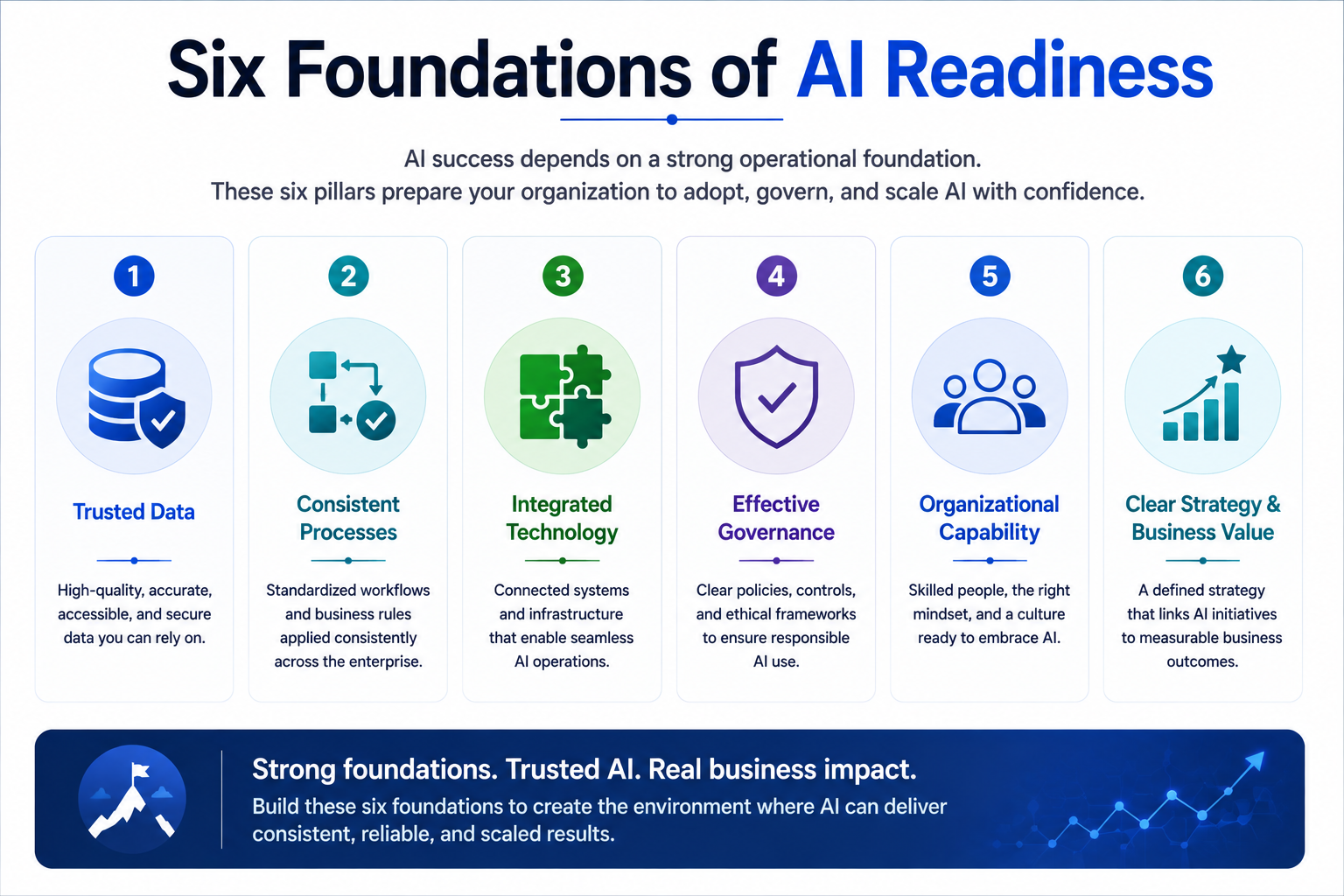 While every organization begins from a different starting point, successful AI adoption consistently depends upon six foundational capabilities. Weakness in any one area can limit the effectiveness of AI, regardless of the sophistication of the technology being implemented.
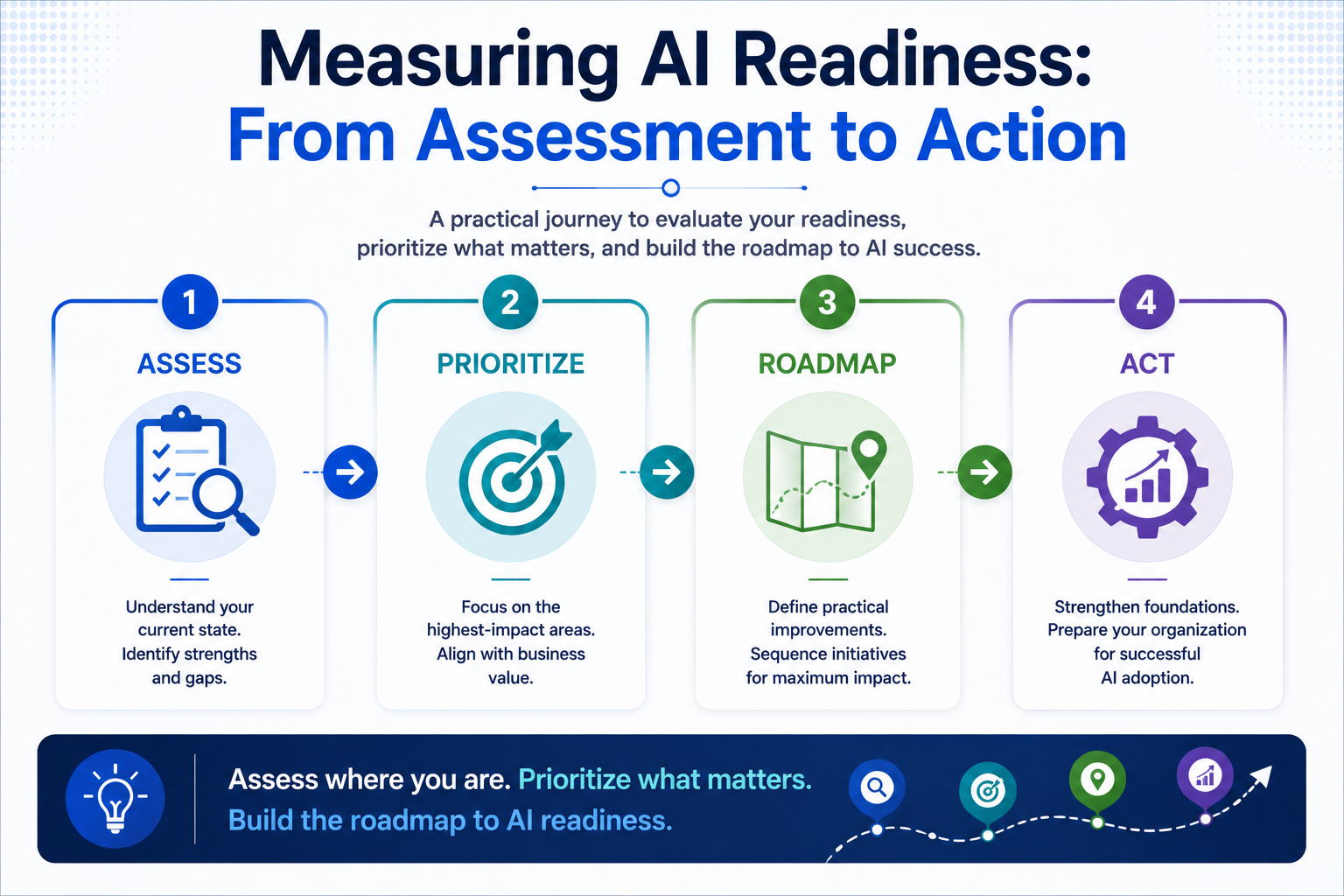 The objective is not to achieve perfection before pursuing AI initiatives. Few organizations begin with every capability fully mature. Instead, the assessment establishes a practical roadmap that enables leaders to make informed investment decisions, reduce implementation risk, and improve organizational readiness over time.
What Is AI Readiness?
AI Readiness was never determined by the technology an organization selects. It has always been determined by the organization AI is asked to support. AI Readiness is an organization’s ability to successfully adopt, govern, and scale AI by establishing the operational foundations required for consistent, reliable, and trusted outcomes. While many organizations approach AI as a technology initiative, AI Readiness extends well beyond selecting AI platforms or deploying new tools. It reflects how prepared the enterprise is to support AI through trusted data, consistent business processes, effective governance, integrated technology, organizational capability, and a clear strategy for creating business value. Organizations that are AI-ready recognize that AI can only perform as effectively as the environment in which it operates. When workflows are inconsistent, business rules are applied differently across the enterprise, or data lacks quality and trust, AI will often amplify those weaknesses rather than overcome them. This is why AI Readiness should be viewed as a business discipline rather than simply a technology initiative. It helps executive leaders evaluate whether the enterprise is prepared to support AI successfully before making additional technology investments, reducing implementation risk while increasing the likelihood of achieving meaningful business outcomes.Why AI Readiness Has Become an Executive Priority
Although the operational foundations of AI Readiness have always existed, the business environment surrounding them has changed dramatically. Artificial intelligence has become a strategic capability that is reshaping how organizations operate, make decisions, and create value. As investment has accelerated, so have executive expectations. Organizations are no longer asking whether AI will influence their business. They are asking how quickly they can adopt it and where it can deliver the greatest value.Research Insight
McKinsey’s 2025 State of AI survey found that AI adoption has become widespread across enterprises, yet organizations creating measurable business value are the ones redesigning workflows, strengthening governance, and making organizational changes alongside technology deployment. The research reinforces that successful AI adoption depends on organizational readiness—not technology implementation alone. – McKinsey & Company, The State of AI: Global Survey (2025) What has changed is not simply the technology. The game has changed. For decades, organizations could often improve business performance by implementing new enterprise applications, modernizing existing systems, or automating individual processes. AI operates differently. Rather than following predefined rules, AI depends on the quality of the operational environment it enters. It learns from enterprise information, supports business decisions, and increasingly becomes part of how work is performed. As a result, AI reflects the operational maturity of the organization itself. It cannot consistently compensate for fragmented workflows, inconsistent business rules, disconnected systems, or data that lacks quality and trust. Instead, it often exposes those challenges while accelerating their impact across the enterprise. This shift requires executives to think differently about AI investment. The first question should no longer be, “Which AI solution should we implement?” It should be, “Is our organization prepared to support AI successfully?” That question represents the beginning of AI Readiness.Why So Many AI Initiatives Fall Short
Previous generations of enterprise technology could often deliver meaningful business value despite operational immaturity. Organizations successfully implemented ERP systems, CRM platforms, workflow automation, analytics, and other enterprise technologies while continuing to rely on disconnected systems, inconsistent processes, manual workarounds, spreadsheet dependencies, and data that was less than ideal. AI changes that equation. Unlike traditional enterprise applications, AI increasingly depends upon the quality of the operational environment in which it operates. It learns from enterprise information, participates in business processes, and influences decisions across the organization. As a result, weaknesses that organizations were once able to compensate for through human judgment and experience become significantly more difficult to overcome. Many organizations continue to approach AI as another technology implementation rather than recognizing it as an organizational capability. They evaluate AI platforms before evaluating operational readiness, often assuming AI will compensate for inconsistent processes, fragmented workflows, disconnected systems, or poor data quality. In reality, AI is more likely to expose those weaknesses than eliminate them.Research Insight
McKinsey’s global AI research continues to show that while AI adoption is becoming nearly universal, only a minority of organizations have successfully scaled AI across the enterprise and achieved significant financial impact. The difference is increasingly tied to workflow redesign, governance, organizational change, and operational integration—not simply deploying additional AI tools. McKinsey & Company, The State of AI: Global Survey (2025) This explains why organizations with significant technology investments may still struggle to achieve meaningful business outcomes from AI. The challenge is rarely the AI technology itself. More often, organizations have not established the operational foundations required for AI to perform consistently and reliably at enterprise scale. AI does not create operational complexity. It reveals it.The Six Foundations of AI Readiness
AI Readiness is not determined by a single capability or technology investment. It reflects how well an organization has established the operational foundations required to support AI consistently, reliably, and at enterprise scale. While every organization begins from a different starting point, successful AI adoption consistently depends upon six foundational capabilities. Weakness in any one area can limit the effectiveness of AI, regardless of the sophistication of the technology being implemented.Governance & Compliance
Effective governance establishes the policies, business rules, accountability, and oversight that enable AI to operate responsibly and consistently. As AI becomes more deeply integrated into business operations, governance must extend beyond documentation and become embedded within operational execution, ensuring decisions are supported by trusted information and consistent business practicesData Quality
AI depends upon accurate, complete, and trusted enterprise data. Organizations should understand where critical data originates, how it is maintained, and whether it can be relied upon to support business decisions. Improving data quality is not simply about cleansing existing information—it begins by creating trusted data through consistent operational execution.Process & Workflow
Consistent business processes provide the structure AI requires to produce reliable outcomes. Organizations that rely heavily on manual workarounds, undocumented exceptions, or inconsistent execution often find those variations reduce AI’s effectiveness. AI performs best when business processes are clearly defined, repeatable, and governed across the enterprise.Technology & Integration
Most organizations already possess significant technology investments. AI Readiness is rarely determined by replacing existing systems. Instead, organizations should evaluate how effectively those systems work together, how information moves across the enterprise, and whether technology enables consistent operational execution rather than creating additional complexity.People & Adoption
Successful AI adoption depends upon more than technical implementation. Leaders, managers, and employees must understand how AI will affect their work, develop the capabilities required to use it effectively, and maintain appropriate human oversight as AI becomes part of everyday operations. Organizations that prepare their people as intentionally as they prepare their technology are significantly better positioned for long-term success.Strategy & Business Value
AI initiatives should support clearly defined business objectives rather than technology experimentation. Organizations should establish measurable outcomes, prioritize initiatives based on business value, and develop a realistic roadmap for adoption. AI Readiness helps ensure technology investments remain aligned with strategic priorities and deliver sustainable business results. Together, these six foundations provide executives with a practical framework for evaluating organizational readiness before expanding AI initiatives. Rather than focusing exclusively on technology selection, leaders can assess the broader organizational capabilities that determine whether AI will deliver meaningful and sustainable business value.Bridging AI Readiness and Enterprise Execution
Understanding AI Readiness is only the beginning. The next challenge facing executive leaders is translating readiness into consistent operational execution across the enterprise. Many organizations already understand the importance of governance, trusted data, standardized processes, and integrated technology. The difficulty lies in applying those capabilities consistently across multiple business units, legacy systems, and day-to-day operations. Policies define expectations, but they do not ensure execution. Technology stores information, but it does not inherently coordinate work across the enterprise. This is where many organizations encounter what Soltec describes as the gap between readiness and execution. Organizations may possess the individual capabilities required to support AI, yet still struggle because those capabilities operate independently rather than as part of a connected operating model. Business processes evolve differently across departments. Data is validated at different points. Governance is applied inconsistently. Employees develop local workarounds to overcome operational constraints. Over time, these differences reduce consistency and weaken the trusted operational foundation AI requires. Enterprise Operational Orchestration helps bridge that gap by connecting people, processes, data, governance, and existing enterprise systems into a governed system of execution. Rather than replacing existing technology investments, it enables organizations to coordinate how work is performed across the enterprise while preserving consistency, visibility, and accountability. This distinction is important. AI Readiness determines whether an organization has established the capabilities required to support AI successfully. Enterprise Operational Orchestration helps operationalize those capabilities by ensuring they are applied consistently as work moves across the organization. Together, they create a stronger foundation for AI adoption. Readiness establishes the conditions for success. Enterprise execution helps sustain those conditions as the organization grows, evolves, and scales its AI capabilities.Measuring AI Readiness: From Assessment to Action
Understanding the principles of AI Readiness is valuable. Knowing how prepared your organization actually is requires a structured assessment. Many executive teams assume they have a clear understanding of their organization’s readiness because individual initiatives appear to be progressing successfully. In reality, AI Readiness extends across multiple business functions, technologies, and organizational capabilities. Without a structured evaluation, strengths in one area can easily mask weaknesses in another. An effective AI Readiness Assessment provides leadership with an objective view of the organization’s current state across the six foundational capabilities discussed in this guide. Rather than producing a simple score, the assessment identifies areas of strength, exposes operational gaps, and helps prioritize the improvements that will have the greatest impact on successful AI adoption. The objective is not to achieve perfection before pursuing AI initiatives. Few organizations begin with every capability fully mature. Instead, the assessment establishes a practical roadmap that enables leaders to make informed investment decisions, reduce implementation risk, and improve organizational readiness over time.Research Insight
Organizations that approach AI as a managed business capability consistently outperform those that rely on isolated pilots or uncoordinated implementations. McKinsey’s research highlights that organizations realizing the greatest value establish governance, executive accountability, workflow redesign, and structured measurement as AI scales across the enterprise. – McKinsey & Company, The State of AI: Global Survey (2025) This assessment-first approach also helps organizations avoid a common mistake—attempting to solve every challenge simultaneously. By understanding where the most significant readiness gaps exist, leaders can focus their efforts on the foundational improvements that will create the greatest business value while supporting future AI initiatives. AI Readiness should not be viewed as a one-time exercise completed before an implementation begins. As organizations evolve, technologies mature, and business priorities change, readiness should be reassessed periodically to ensure the operational foundations continue to support new opportunities and increasing organizational complexity. A structured assessment transforms AI Readiness from a broad strategic concept into a practical business roadmap. It provides executive leaders with the insight needed to prioritize investments, align organizational capabilities, and move forward with greater confidence.Where Organizations Should Begin
For many executive teams, the greatest challenge is not understanding the importance of AI Readiness. It is determining where to begin. Organizations often feel pressure to move quickly as AI capabilities continue to evolve. Yet attempting to improve every process, modernize every system, or resolve every operational challenge before pursuing AI is neither practical nor necessary. Successful organizations begin by establishing a clear understanding of their current state and focusing on the improvements that will create the greatest business value. The first step is gaining an objective view of organizational readiness. Leaders should understand how well governance, data quality, business processes, technology, organizational capability, and strategic alignment support future AI initiatives. This creates a fact-based foundation for prioritizing investments rather than relying on assumptions or individual perspectives.Executive Perspective
“Throughout my career, the organizations that achieved the most sustainable results weren’t necessarily the ones that moved the fastest. They were the ones that invested the time to understand how work was actually being performed before deciding how it should change. Technology can accelerate improvement, but it cannot replace operational understanding.” — Chris Evanoff, President & Founder, Soltec From there, organizations should identify a limited number of high-value opportunities where improvements can be demonstrated, measured, and refined before expanding to broader enterprise initiatives. Early success builds organizational confidence, strengthens adoption, and provides valuable experience that can be applied as AI capabilities continue to mature. Equally important, organizations should recognize that AI Readiness is not owned by a single department. While technology plays an important role, successful AI adoption requires active participation from executive leadership, business functions, operations, governance, and the people responsible for executing work every day. AI Readiness is an enterprise capability that depends upon cross-functional alignment and shared accountability. Organizations that approach AI Readiness as an ongoing business discipline rather than a one-time project are better positioned to adapt as technologies evolve and new opportunities emerge. By building strong operational foundations first, they create an environment where AI can deliver sustainable business value rather than isolated technology successes.How Soltec Helps Organizations Become AI Ready
Every organization begins its AI journey from a different starting point. Some are focused on improving data quality. Others are modernizing legacy systems, strengthening governance, or evaluating where AI can deliver the greatest business value. Regardless of where an organization begins, successful AI adoption depends upon understanding its current operational readiness before expanding technology investments. Soltec helps organizations evaluate and strengthen the operational foundations required for successful AI adoption. Our approach begins with an AI Readiness Assessment that provides executive leaders with an objective view of organizational strengths, readiness gaps, and opportunities for improvement across the six foundational capabilities discussed throughout this guide. Rather than recommending technology for technology’s sake, Soltec works with organizations to improve workflow consistency, strengthen governance, establish trusted data, align existing enterprise systems, and prepare leaders and employees for successful AI adoption. The objective is to create an operational environment where AI can consistently deliver measurable business value. When organizations are ready to move from assessment to execution, Soltec helps bridge that transition through Enterprise Operational Orchestration. By connecting people, processes, governance, data, and existing enterprise systems into a governed system of execution, organizations can apply AI with greater confidence while preserving operational consistency, visibility, and accountability. AI Readiness is not a destination achieved through a single implementation. It is an organizational capability that continues to mature as the business evolves. Organizations that invest in strong operational foundations today will be better positioned to adapt to new technologies, scale AI initiatives, and create sustainable business value in the years ahead.Executive Takeaways
Before investing further in AI, executive leaders should ask:- Is our organization operationally prepared to support AI successfully?
- Can we trust the data AI will rely upon to make recommendations and support decisions?
- Are our business processes consistent enough to produce reliable outcomes?
- Is governance embedded within operational execution or primarily documented through policies and procedures?
- Do our existing enterprise systems work together effectively, or do disconnected processes create unnecessary complexity?
- Have we prepared our leaders and employees to successfully adopt AI as part of their everyday work?
- Are we treating AI Readiness as a technology initiative or as an enterprise capability?
Final Thought:
Organizations do not become AI-ready by implementing AI. They become AI-ready by preparing the enterprise AI is entering.Frequently Asked Questions:
What Is AI Readiness?
AI Readiness is an organization’s ability to successfully adopt, govern, and scale Artificial Intelligence (AI) by establishing the operational foundations required for consistent, reliable, and trusted business outcomes. It extends far beyond selecting AI technologies or developing implementation plans. Organizations become AI-ready by strengthening the capabilities that enable AI to succeed, including governance, trusted data, consistent business processes, technology integration, organizational capability, and strategic alignment. When these foundations are in place, AI can produce more accurate insights, support better decision-making, and scale across the enterprise with greater confidence. AI Readiness should be viewed as a business discipline rather than a technology initiative. Organizations that evaluate and strengthen their readiness before expanding AI investments are better positioned to reduce implementation risk, improve adoption, and achieve measurable business value.Why do AI initiatives fail even after significant technology investments?
Many AI initiatives fall short not because the technology is incapable, but because the organization is not adequately prepared to support it. AI depends on trusted data, consistent business processes, effective governance, and organizational alignment to produce reliable results. When these foundational capabilities are weak, AI often exposes existing operational challenges rather than solving them. Organizations frequently invest significant time evaluating AI platforms while spending far less time assessing whether their operational environment is ready for AI adoption. Inconsistent workflows, disconnected enterprise systems, poor data quality, and unclear governance can all limit AI’s ability to deliver meaningful business value, regardless of the sophistication of the technology. Successful AI adoption begins by preparing the enterprise before expanding AI investments. Organizations that strengthen their operational foundations first are better positioned to scale AI confidently, reduce implementation risk, and achieve sustainable business outcomes.What should executives evaluate before investing in AI?
Before investing in AI, executive leaders should evaluate whether their organization has the operational foundations required to support successful AI adoption. Selecting the right AI technology is important, but technology alone cannot overcome inconsistent business processes, poor data quality, weak governance, or fragmented enterprise systems. An effective evaluation should examine the organization’s readiness across six core areas: governance, data quality, business processes and workflows, technology and integration, organizational capability, and strategic alignment. Together, these capabilities determine whether AI can consistently deliver reliable insights and measurable business value. Rather than asking, “Which AI solution should we buy?” leaders should first ask, “Is our organization prepared to use AI successfully?” That shift in perspective helps organizations prioritize foundational improvements, reduce implementation risk, and make more informed technology investments.What is an AI Readiness Assessment?
An AI Readiness Assessment is a structured evaluation of an organization’s ability to successfully adopt, govern, and scale Artificial Intelligence (AI). Rather than focusing solely on technology, it examines the operational capabilities that determine whether AI can consistently deliver reliable business outcomes. A comprehensive assessment evaluates the organization’s readiness across six foundational areas: governance, data quality, business processes and workflows, technology and integration, organizational capability, and strategic alignment. The objective is to identify organizational strengths, uncover readiness gaps, and prioritize the improvements that will have the greatest impact on successful AI adoption. An AI Readiness Assessment is not intended to determine whether an organization should invest in AI. Instead, it helps executive leaders understand how prepared the organization is to realize value from those investments. The result is a practical roadmap that reduces implementation risk, improves decision-making, and establishes a stronger foundation for long-term AI success.How does workflow consistency improve AI success?
AI performs best when it operates within consistent, well-defined business processes. When the same work is performed differently across departments, locations, or business units, AI receives inconsistent inputs, encounters conflicting business rules, and produces less reliable results. Workflow consistency helps ensure that data is captured, validated, and managed in a predictable manner before it reaches AI models. It also improves governance, strengthens accountability, and creates greater confidence in the recommendations and insights AI generates. Simply put, consistent execution produces more consistent outcomes. Organizations do not need every process to be identical before adopting AI. However, they should understand where variations exist, determine which differences are intentional versus unintended, and establish appropriate governance around critical business processes. Strengthening workflow consistency creates a more stable operational environment where AI can deliver measurable and sustainable business value.Why is trusted enterprise data essential for AI?
AI can only produce reliable insights when it is built upon trusted enterprise data. If business data is incomplete, inconsistent, inaccurate, or governed differently across systems, AI will often amplify those issues rather than correct them. The quality of AI outputs is directly influenced by the quality and consistency of the information it receives. Trusted enterprise data is more than accurate data. It is data that is consistently defined, validated, governed, and managed across the organization so that employees, business systems, and AI operate from the same foundation. This improves confidence in AI-generated recommendations, supports better decision-making, and reduces operational risk. Improving AI outcomes does not always require collecting more data. In many cases, it begins with improving the quality, consistency, and governance of the data the organization already possesses. Organizations that invest in trusted enterprise data create a stronger foundation for AI adoption, operational excellence, and long-term business value.What role does governance play in AI Readiness?
Governance provides the structure, accountability, and consistency that enable AI to operate responsibly and reliably across the enterprise. While AI often focuses attention on algorithms and models, governance ensures the data, business processes, decision-making, and operational controls supporting AI are consistent, transparent, and aligned with organizational objectives. Effective AI governance extends beyond policies and compliance documentation. It establishes clear ownership, standardized business rules, defined decision rights, and ongoing oversight throughout operational execution. When governance is embedded where work is performed, organizations improve data quality, strengthen accountability, reduce operational risk, and increase confidence in AI-generated insights. Governance should not be viewed as a barrier to innovation. It is an enabler of sustainable AI adoption. Organizations that integrate governance into everyday operations are better positioned to scale AI responsibly while maintaining consistency, trust, and business performance.How is Enterprise Operational Orchestration connected to AI Readiness?
Enterprise Operational Orchestration (EOO) helps organizations move from AI Readiness to AI execution. While AI Readiness focuses on establishing the operational foundations required for successful AI adoption, Enterprise Operational Orchestration helps those foundations work together consistently across the enterprise. Many organizations already have the core technologies needed to support AI, including ERP systems, business applications, analytics platforms, and governance frameworks. The challenge is that these capabilities often operate independently, creating disconnected workflows, inconsistent execution, and fragmented data. Enterprise Operational Orchestration provides a governed execution layer that connects people, processes, data, governance, and existing enterprise systems into a more coordinated operating environment. Rather than replacing existing technologies, Enterprise Operational Orchestration helps organizations improve how those technologies work together. This creates the operational consistency, visibility, and governance that enable AI to deliver more reliable insights, support better decision-making, and scale with greater confidence.Can organizations improve AI Readiness without replacing existing systems?
Yes. In most cases, improving AI Readiness does not require replacing existing enterprise systems. Organizations often realize greater value by improving how their current technologies, business processes, data, and governance work together rather than undertaking large-scale system replacement initiatives. Many organizations already have significant investments in ERP, CRM, manufacturing, finance, human resources, and other enterprise applications. The challenge is frequently not the capabilities of those systems, but the operational complexity created when they function independently, follow inconsistent processes, or rely on fragmented data. Strengthening governance, improving workflow consistency, and establishing trusted enterprise data can significantly increase the value organizations realize from their existing technology investments. AI Readiness is about preparing the enterprise—not replacing it. Organizations that build stronger operational foundations around their current systems are often better positioned to adopt, scale, and sustain AI while maximizing the value of the technology investments they have already made.Is AI Readiness a technology initiative or a business initiative?
AI Readiness is fundamentally a business initiative supported by technology. While AI platforms, infrastructure, and technical capabilities are important, successful AI adoption depends on the organization’s ability to align people, processes, governance, data, and technology toward a common business objective. Treating AI Readiness as solely an IT initiative often overlooks the operational capabilities that determine whether AI can consistently deliver business value. Executive leadership, business functions, operations, information technology, and governance all play essential roles in preparing the organization for successful AI adoption. AI succeeds when the enterprise is prepared—not simply when the technology is deployed. Organizations that approach AI Readiness as an enterprise-wide business capability are better positioned to prioritize investments, improve collaboration across functions, strengthen operational execution, and scale AI with greater confidence. Technology enables AI, but organizational readiness determines whether AI delivers sustainable business results.

Mark Kruckeberg is the Managing Partner of Soltec and a recognized leader in enterprise transformation, operational excellence, governance, and AI readiness. With more than 26 years of experience leading large-scale business, operational, and technology initiatives, Mark has helped organizations improve execution, strengthen governance, optimize workflows, and build trusted data foundations. Today, he works with enterprise leaders to improve operational performance, organizational readiness, and long-term business outcomes while preparing their organizations for successful AI adoption and future innovation.