Empowering Business Transformation: Check out our Technology and AI Readiness solutions Learn More

AI Readiness

Organizational Change Readiness Banner Image
AI Readiness, Soltec

Organizational Change Readiness: Preparing Your Organization For Successful Transformation

Successful organizational change begins long before communication plans, training sessions, or implementation activities. Organizations that prepare their people as intentionally as they prepare their technology are significantly better positioned to achieve lasting business outcomes. What Is Organizational Change Readiness? Organizational Change Readiness is an organization’s ability to successfully prepare its leaders, managers, employees, and operational processes to adopt and sustain new ways of working. While Organizational Change Management is often associated with communication plans, stakeholder engagement, and training, change readiness begins much earlier. It focuses on understanding how change will affect the enterprise, identifying potential barriers to adoption, developing the capabilities needed for success, and preparing the organization before implementation begins. Technology rarely creates business value on its own. People create business value by adopting new processes, embracing new ways of working, and consistently applying those changes throughout the enterprise. This is why Organizational Change Readiness should be viewed as a strategic business capability rather than simply a project activity. It helps leadership prepare the enterprise for change before the first implementation milestone is reached, reducing uncertainty, improving adoption, and increasing the likelihood of achieving the intended business outcomes. Why Do Organizations Struggle with Change? Most organizations do not struggle with change because employees resist new ideas. They struggle because leadership often underestimates the organizational effort required to successfully adopt new ways of working. Research Insight McKinsey research found that only 3% of transformation initiatives were reported as successful when line managers or frontline employees were not actively engaged throughout the transformation process. The findings reinforce that successful organizational change depends on leadership engagement and workforce involvement—not technology implementation alone. Source: McKinsey & Company, “Successful Transformations.” Technology implementations typically receive significant attention long before deployment. Project plans are developed, budgets are approved, timelines are established, and future operating models are designed. Yet many organizations spend comparatively little time understanding how those decisions will affect the people responsible for executing them every day. As a result, important assumptions are often made before leadership fully understands how work is currently performed across the enterprise. Operational complexity, undocumented processes, local workarounds, and informal business practices may not become visible until implementation is already underway, when changes become significantly more difficult—and more costly—to address. Successful organizational change begins with understanding the current state before designing the future state. When leaders invest time in understanding how work is actually performed, how responsibilities will change, and what capabilities employees will need to succeed, they create a stronger foundation for communication, training, adoption, and long-term organizational success. Organizations rarely struggle because they planned too much. More often, they struggle because they planned with an incomplete understanding of the enterprise they were asking to change. Change Readiness vs. Change Management Although the terms are often used interchangeably, Organizational Change Readiness and Organizational Change Management serve different purposes. Understanding the distinction helps organizations prepare more effectively for successful transformation. Change Readiness focuses on preparing the enterprise before implementation begins. It helps leaders understand how change will affect the organization, identify potential risks, evaluate organizational capabilities, and establish the conditions necessary for successful adoption. Change Management focuses on helping people successfully navigate the change once implementation is underway. It emphasizes communication, stakeholder engagement, training, coaching, and reinforcement to support adoption and long-term success. Organizations achieve the greatest results when both capabilities work together. Readiness establishes the foundation for change, while Change Management helps the organization successfully execute and sustain it. Organizational Change Readiness Organizational Change Management Prepares the enterprise before implementation Supports people throughout implementation Evaluates organizational readiness and capability Communicates, trains, and reinforces change Identifies risks, barriers, and organizational impacts Addresses adoption, engagement, and resistance Helps leadership understand the current state Helps employees transition to the future state Builds confidence before change begins Sustains change after implementation Organizations that focus exclusively on Change Management often discover organizational issues after implementation has already begun. Investing in Change Readiness first allows leadership to make better-informed decisions, reduce avoidable disruption, and create a stronger foundation for long-term success. What Role Does Leadership Play in Organizational Change? Leadership is the single most important factor influencing the success of organizational change. While project teams manage implementation activities, leaders establish the direction, priorities, and organizational confidence that determine whether change is ultimately embraced or resisted. Research Insight McKinsey research found that organizations where senior leaders communicate openly and consistently throughout a transformation are eight times more likely to report successful outcomes. For enterprise-wide transformations, that likelihood increases to 12.4 times when executive communication remains active throughout the initiative. Source: McKinsey & Company, “Successful Transformations.” Executive Observation Throughout my career leading large-scale organizational transformations, I found that employees rarely expected leadership to have every answer. What they wanted was confidence that leadership understood how the proposed changes would affect their work. When employees believe decisions are being made with an understanding of operational reality rather than assumptions, they are far more likely to engage with change instead of resisting it. Effective leadership during change extends beyond executive sponsorship. It requires developing a clear understanding of how the organization operates today, communicating why change is necessary, making informed decisions that reflect operational realities, and ensuring managers are prepared to lead their teams through uncertainty. Employees rarely expect leaders to have every answer. They do expect leaders to demonstrate clarity, consistency, and a genuine understanding of how proposed changes will affect the people responsible for executing them. When leadership makes decisions without fully understanding the operational impact, organizations often experience avoidable disruption, declining confidence, inconsistent adoption, and increased resistance—not because employees oppose change, but because they struggle to understand how they will succeed within it. Successful leaders invest as much effort preparing their people as they do preparing their technology. They recognize that organizational capability is built through understanding, engagement, communication, and continuous leadership long before implementation begins. Ultimately, employees do not adopt change because a project plan tells them to. They adopt change because leadership has prepared the organization to succeed. How Does Organizational Change Support

AI Readiness, Soltec

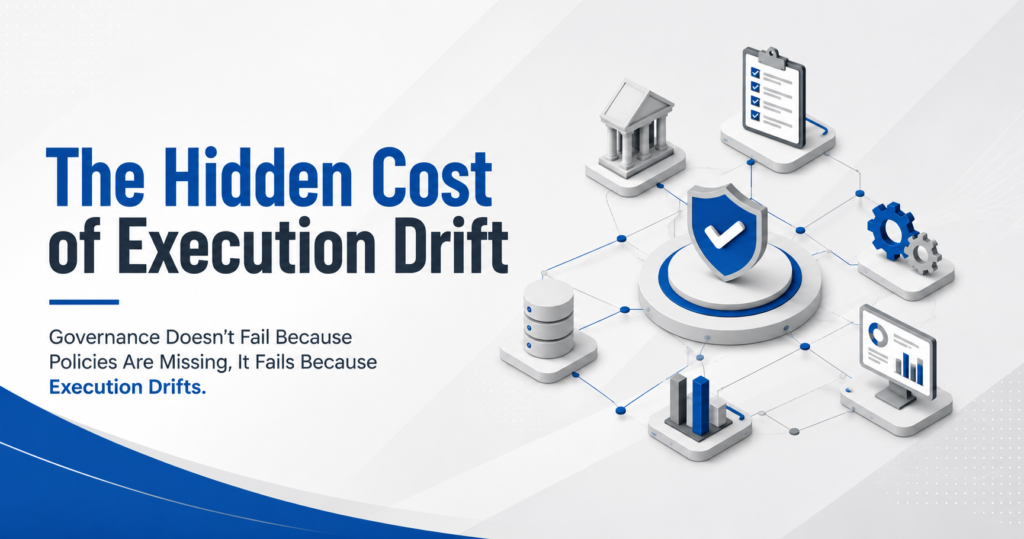
Governance Doesn’t Fail Because Policies Are Missing, It Fails Because Execution Drifts

Governance is often discussed in terms of policies, compliance, and risk management. Yet organizations rarely lose governance because documentation is missing—they lose it as everyday execution gradually drifts over time. This article explores why governance must become an operational capability that strengthens execution, trusted data, and AI Readiness. Introduction Governance is often viewed as a collection of policies, procedures, compliance requirements, and oversight activities designed to reduce organizational risk. Yet many organizations with mature governance programs continue to struggle with inconsistent execution, poor data quality, audit findings, and operational inefficiencies. The challenge is rarely that governance is missing. More often, governance gradually weakens as operational execution drifts over time. Processes evolve. Business priorities change. Teams develop workarounds. Manual steps are introduced. Exceptions become routine. Individually, these changes often make perfect business sense. Collectively, they create a growing gap between how the organization believes work is performed and how work is actually performed. This distinction matters because governance is ultimately measured by the consistency of everyday execution—not by the quality of the policies stored on a shared drive. Organizations that sustain strong governance don’t simply document how work should happen. They embed governance into everyday execution, where work is performed, decisions are made, and trusted data is created. What Is Governance Really Trying to Achieve? Governance exists to ensure that work is performed consistently, decisions are made appropriately, and trusted data is created throughout the organization. Its purpose is not simply to document how work should happen, but to help ensure that work is performed that way every day. Many organizations associate governance with policies, compliance programs, audit requirements, or risk management. While these are important components of governance, they are not its primary objective. Governance exists to create consistency across the enterprise so that people, processes, systems, and data work together in a predictable, controlled, and measurable way. When governance is effective, employees understand how decisions should be made, business rules are applied consistently, approvals follow established processes, and data is created and maintained according to agreed standards. Leaders gain greater visibility into operational performance because execution is consistent rather than dependent upon individual experience or institutional knowledge. In other words, governance is not an administrative function operating alongside the business. It is an operational capability that enables the business to execute consistently while reducing risk, improving data quality, and strengthening organizational alignment. Why Does Governance Drift Over Time? Governance rarely fails overnight. More often, it gradually weakens as organizations evolve, priorities shift, and everyday execution begins to diverge from established processes. Most organizations don’t intentionally abandon governance. In fact, many continue investing in governance programs, compliance initiatives, and risk management activities for years. Yet despite those investments, execution often becomes less consistent over time. The reason is simple: businesses are constantly changing. Organizations acquire new companies. Business processes evolve. New technologies are introduced. Regulations change. Teams reorganize. Experienced employees retire. New employees develop different ways of working. Temporary workarounds become permanent practices. Manual spreadsheets fill operational gaps. Exceptions that were once uncommon become part of everyday execution. Individually, each of these changes often makes sense. Together, they gradually create operational drift. As execution drifts, governance becomes increasingly difficult to sustain. Business rules are applied inconsistently. Similar work is performed differently across departments. Data is created using different standards. Leaders lose visibility into how work is actually being performed, making governance more difficult to monitor and enforce. Measured Business Outcomes Based on approved Manch Technologies customer implementations, organizations that embedded governance into everyday operations demonstrated measurable business improvements beyond compliance alone, including: Business partner onboarding reduced from 7–10 days to 2 days Validation effort reduced by more than 90% Governed workflows expanded from a single business process to more than 25 operational workflows These results demonstrate that governance is not simply about reducing risk—it also enables faster execution, greater consistency, and improved operational performance. This is one of the reasons enterprise complexity has become such an important business challenge. The more systems, processes, business units, and data domains an organization manages, the more opportunities exist for execution to drift unless governance becomes part of everyday operations. Why Is Governance More Than Policies? Policies establish expectations. Governance ensures those expectations are carried out consistently through everyday execution. Without consistent execution, even the best policies gradually lose their effectiveness. Most organizations have no shortage of documented policies, procedures, and operating standards. Defining how work should be performed is rarely the challenge. Sustaining that consistency as the organization evolves is. When governance relies primarily on documentation, it becomes increasingly difficult to maintain consistency. Employees develop workarounds to solve immediate business needs. Different departments interpret policies differently. Manual approvals bypass established processes. Local practices emerge that differ from enterprise standards. Over time, the documented process and the operational reality begin to diverge. This is why governance should not be viewed as a periodic compliance exercise. It should be viewed as an operational discipline that supports the way work is performed every day. The strongest governance programs don’t simply define business rules—they embed those rules into operational workflows, approval processes, and decision-making so that governance becomes part of execution rather than an activity performed outside of it. How Does Operational Execution Impact Governance? Operational execution is where governance either succeeds or fails. Governance becomes sustainable when business rules, approvals, workflows, and data standards are consistently applied as work is performed—not after the fact through audits or corrective actions. Every business process creates decisions. Customer records are established. Suppliers are onboarded. Products are introduced. Contracts are approved. Financial transactions are processed. Each of these activities represents an opportunity to either strengthen governance through consistent execution or introduce additional variability into the organization. When operational execution is governed, business rules are applied consistently, approvals follow established workflows, exceptions are visible, and trusted data is created at the point of execution. Leaders gain confidence that work is being performed according to enterprise standards because governance is embedded directly into the process rather than evaluated only after the

Scroll to Top