
Prepare Your Enterprise for AI.
Your AI, automation, and business operations are only as reliable as the data behind them. Soltec helps enterprises improve master data quality, governance, and consistency—creating trusted data foundations for operational excellence and AI readiness.
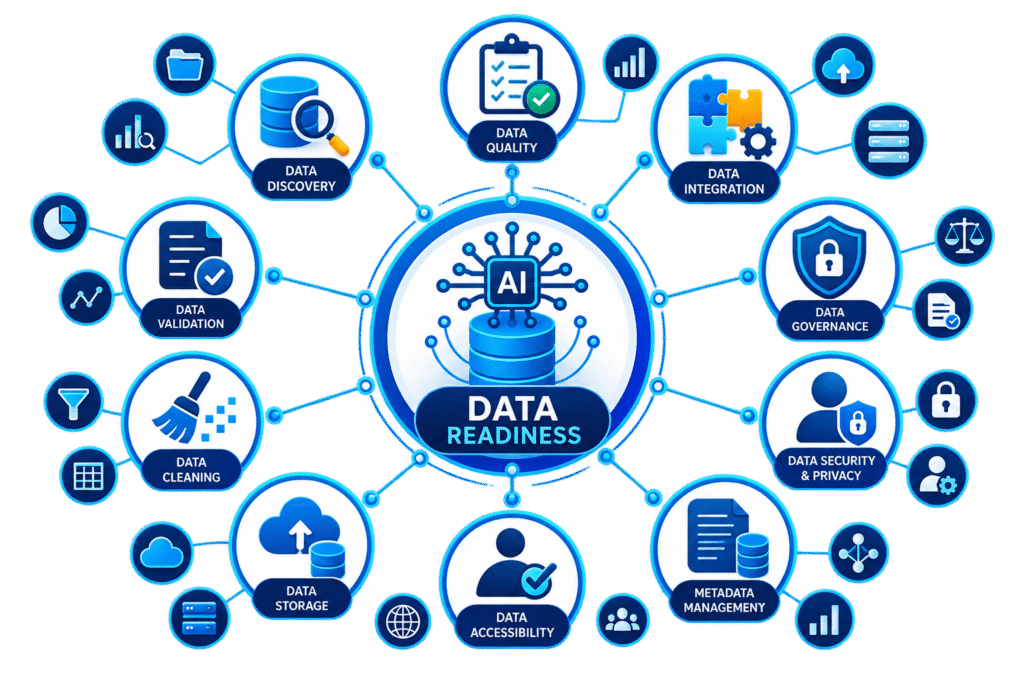
MDM & AI Readiness
AI Readiness Starts with Trusted Enterprise Data
Master Data Management is more than a data discipline—it creates the trusted data foundation that makes AI reliable, workflows consistent, and enterprise operations scalable.

Reliable AI-Ready Data
Accurate and validated information that AI and analytics can trust — preventing bad inputs from producing bad outputs.

Consistent Enterprise Data
Standardised customer, vendor, product, and other critical master data — consistent across all systems and business functions.

Strong Data Governance
Clear ownership, controls, standards, and accountability — ensuring data quality is maintained as the enterprise evolves.

Better Operational Execution
Reliable data flowing consistently across systems and workflows — reducing errors, rework, and operational disruption.
Business Impact
Business Impact of Poor Master Data
Duplicate records, inconsistent reporting, process delays, and ungoverned data create compounding operational and strategic risk across the enterprise.

Duplicate & Inconsistent Records
Duplicate customer, vendor, and product records create conflicting information across systems — leading to errors in billing, fulfilment, and reporting.

Manual Reconciliation Burden
Teams spend significant time manually identifying, reconciling, and correcting data inconsistencies — capacity that should be
directed at higher-value work.

Process Delays & Errors
Workflows that depend on inaccurate or incomplete data experience delays, exceptions, and rework — increasing cycle times and operational costs.

Unreliable Reporting
Inconsistent master data produces conflicting reports across business units — reducing leadership confidence and slowing decision- making.
Compliance & Governance Risk
Poor data governance creates audit gaps, compliance exposure, and regulatory risk — particularly in regulated industries where data traceability is required.

Unreliable AI & Analytics
AI models trained on inaccurate or inconsistent data produce unreliable outputs — undermining the value of analytics and automation investments.
Our Approach
How Soltec Helps Enterprises Build Trusted Master Data
Six core capabilities that address every dimension of your master data challenge — from
discovery to sustained governance.
Data Assessment & Discovery
Identify data quality gaps, duplication, inconsistencies, ownership issues, and critical master data dependencies across enterprise systems.
Data Quality & Validation
Cleanse, validate, enrich, and improve enterprise data — addressing inaccuracies, duplicates, and completeness issues at the source.

Master Data Standardisation
Create consistent definitions, structures, standards, and business rules across systems — establishing a single authoritative version of critical data.
Data Governance & Ownership
Establish ownership, accountability, controls, policies, and governance structures that sustain data quality as the enterprise evolves.

Data Validation & Onboarding
Improve how new customer, vendor, product, and other master data enters enterprise systems — preventing quality issues before they propagate.

Data Alignment & Workflow Integration
Ensure trusted data moves consistently across workflows, applications, and business functions — connecting MDM to operational execution.
Our Framework
Soltec Data Quality Framework
A proven five-phase model that takes enterprises from inconsistent, ungoverned data to a trusted, AI-ready data foundation.
01
Assess
Understand current data sources, quality, ownership, and dependencies across all critical master data domains.
02
Cleanse
Identify and correct duplicate, incomplete, inaccurate, and inconsistent data across enterprise systems.
03
Standardise
Create common definitions, standards, validation rules, and structures — establishing the enterprise data baseline
04
Govern
Establish ownership, controls, accountability, and ongoing data governance to sustain quality over time.
05
Sustain
Continuously monitor data quality and maintain trusted master data as the enterprise and its systems evolve.
MDM & AI Readiness Alignment
Trusted Data Is the Foundation of AI Readiness
Every AI initiative, automation programme, and analytics platform depends on the quality, consistency, governance, and accessibility of enterprise data. Without trusted master data, every downstream system inherits the same underlying problems.
Quality
Data Quality
Accurate, complete, and validated
information — the minimum requirement for any AI or analytics initiative to produce reliable results.
Consistency
Data Consistency
Standardised information across enterprise systems — ensuring that every application and business function works from the same version of truth.
Governance
Data Governance
Clear ownership, policies, controls, and accountability — sustaining data quality over time and providing the audit trail regulators and AI governance frameworks require.
Accessibility
Data Accessibility
The right data available to the right systems and users — ensuring AI models, analytics platforms, and business teams can access trusted data when they need it.
Traceability
Data Traceability
Clear lineage and understanding of where critical data originates — essential for AI model transparency, compliance, and audit readiness.
AI Readiness
AI Reliability
Higher-quality inputs that support more reliable AI and analytics outcomes — reducing model drift, bias risk, and the operational cost of AI failures.
Quality + Governance + Consistency = AI-Ready Data
All three dimensions must be in place. Strong quality without governance erodes over time. Governance without consistency produces siloed, conflicting records. Consistency without quality standardises the wrong information.
Connected Services
Data Quality & Operational Excellence
Trusted master data does not exist in isolation — it enables better workflows, stronger
governance, reliable AI, and validated data onboarding across the enterprise.
Better Workflows
Trusted data flowing consistently through
automated workflows reduces errors, exceptions, and manual intervention — enabling scalable, reliable process execution.
Process Workflow Automation
Stronger Governance
Data governance and GRC frameworks work together — MDM provides the data controls, GRC provides the risk and compliance
structure that keeps both accountable.
GRC Readiness
AI Readiness
Trusted master data is the prerequisite for every AI initiative. Without it, AI models inherit data problems and produce unreliable, ungoverned outputs at scale.
AI Readiness
Data Validation & Onboarding
Preventing data quality issues at the point of entry — validating new customer, vendor, and product data before it enters enterprise systems and workflows.
Data Validation & Onboarding
Talk with Soltec experts to assess your master data quality, governance maturity, operational readiness, and AI readiness.
Frequently Asked
Data readiness, answered straight.
Ensure all required data is accurate, complete, and organized so it’s ready for analysis, automation, or decision-making.
What is Master Data Management (MDM)?
Master Data Management (MDM) creates and maintains a trusted, consistent version of critical business data across enterprise systems.
Why is Master Data Management important for AI readiness?
AI depends on accurate and governed data. MDM provides the trusted data foundation required for reliable AI outcomes.
What does it mean for data to be AI-ready?
AI-ready data is accurate, complete, consistent, governed, and accessible for analytics and AI applications.
What is the difference between Master Data Management and Data Governance?
MDM manages critical business data, while Data Governance defines the policies, ownership, and controls that maintain data quality.
How does poor data quality affect AI and business operations?
Poor-quality data leads to unreliable AI results, reporting errors, inefficient workflows, and increased operational risk.
How can an enterprise assess its master data quality?
By evaluating data accuracy, completeness, consistency, governance, ownership, and validation across enterprise systems.
How long does a Master Data Management initiative take?
The timeline depends on the organization’s size, data complexity, and implementation scope.
What types of master data should an organization manage?
Organizations typically manage customer, supplier, product, material, employee, financial, asset, and location data.