The Missing Layer Between Strategy and Execution.
Enterprise Execution Challenge
The Enterprise Execution Gap
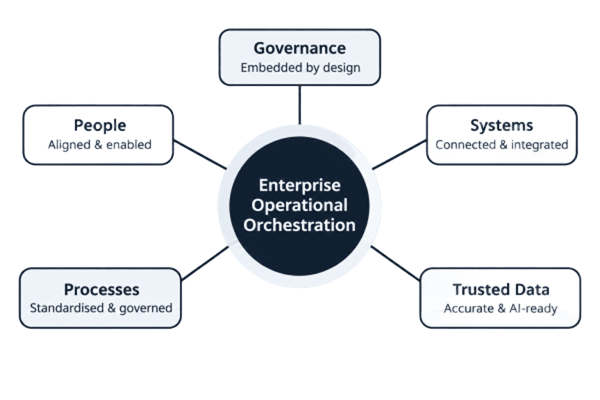
What EOO is & What EOO is Not
What Enterprise Operational Orchestration Is - and Is Not
Connect Strategy to Execution
What EOO IS
EOO
A governed system of execution
Coordinates people, processes,
systems, governance, and data into
one execution layer.
EOO
Connect Strategy to Execution
Closes the gap between enterprise
priorities and day-to-day operational
reality.
EOO
Governance embedded into
execution
Controls, accountability, and audit
trails built into how the enterprise
operates — not added after.
EOO
Trusted data as an execution input
Master data quality and consistency
treated as a prerequisite to reliable
workflows and AI outcomes.
EOO
A continuous operating discipline
Not a one-time program — an
ongoing capability that monitors,
adjusts, and improves over time.
What EOO Is NOT
NOT ERP
A transaction management system
ERP manages transactions within
modules. EOO orchestrates how work
flows across ERP and all other systems.
NOT Workflow Automation
Step-level process execution
Automation executes defined steps.
EOO governs the entire execution
environment those steps depend on.
NOT AI
An output-generation platform
AI produces outputs from data. EOO
creates the governed environment that
makes those outputs reliable.
NOT GRC
A risk and compliance framework
GRC defines policies. EOO embeds
governance into how the enterprise
executes — operationally, not
periodically.
NOT MDM / BPA / OCM
A single-domain solution
MDM creates trusted data. BPA optimizes processes. OCM manages
people. EOO coordinates all of them
simultaneously.
EOO connects and coordinates all of them.
ERP, AI, Workflow Automation, GRC, MDM, BPA, and OCM each deliver value within their domain. EOO is the layer that makes them work together – producing enterprise-level outcomes none can deliver alone.
Six Principles
The Six Principles of Enterprise Operational Orchestration

Coordinated Across All Dimensions

Governance Embedded by Design

Trusted Data as Execution Input

Connect Strategy to Execution

Continuous Improvement by Default

People & organizational Enablement
Soltec Portfolio
How Enterprise Operational Orchestration Unifies the Soltec Portfolio
Enterprise Operational Orchestration provides the connective discipline across the Soltec portfolio, bringing together capabilities such as AI Readiness, Workflow Automation, GRC, Master Data Management, and Organizational Change Management to strengthen enterprise execution.
Enterprise Operational Orchestration
AI
Readiness
Reliable, governed AI adoption
Workflow Automation
Consistent cross-system execution
MDM &
Data
GRC
Readiness
Organizational Change Management
People & adoption
alignment
Manch Platform
The Manch Platform Enables EOO
Once an enterprise understands what EOO requires, the next question becomes: what technology enables it at scale?
THE MANCH PLATFORM
One Control Plane. All Workflows. All Systems.
Centralized workflow orchestration
Single control plane across all systems & teams
Approvals, controls & audit trails in every workflow
Quality enforced before entering enterprise systems
Workflows evolved by business & IT teams together
Consistent, validated data to AI & analytics platforms
Partner & Vendor Onboarding
Traditional platforms depend on third-party tools for verification and compliance — adding delays and integration risk
End-to-end onboarding with embedded verification, approvals, and document controls — consistent and auditable from day one
Embedded Governance & Compliance
Governance is layered on after deployment — creating audit gaps, rework, and compliance risk.
Governance, controls, and auditability embedded directly into workflows — enforced by design, not retrofitted.
Data Quality at Point of Execution
Most platforms identify data issues only after they enter enterprise systems — requiring costly cleanup and reconciliation.
Data validated as workflows execute — preventing errors before they propagate and ensuring AI-ready data outputs

Business Outcomes
Business Outcomes of Enterprise Operational Orchestration

Execution Consistency
Governance at Scale

Real-Time Operational Visibility

AI-Ready Data Foundation

Measurable ROI
Why Soltec
Why Soltec for EOO
Strategy Before Technology
Soltec combines enterprise consulting expertise, operational knowledge, governance, and technology to help organizations strengthen execution before scaling technology investments.
35+ Years of Enterprise Experience
Deep enterprise expertise across manufacturing, automotive, supply chain, and financial services.
Governance-Driven Execution Design
Accountability and controls embedded from day one — not retrofitted after implementation.
Workflow Redesign Before Automation
We design and govern first — ensuring Manch scales the right behaviors, not the wrong ones.
Organizational Enablement Included
OCM is built into every EOO engagement — people must execute as consistently as systems do.
Manch Platform - Built for EOO
The centralized orchestration layer that connects systems, enforces governance, and validates data at scale.
START YOUR EOO JOURNEY
Close the gap between strategy and execution.
Discover how Enterprise Operational Orchestration can help your organization connect people, processes, systems, governance, and trusted data to improve enterprise execution.