
As organizations move from experimenting with AI to deploying it across the enterprise, governance becomes increasingly important.
The conversation often begins with AI policies, security, privacy, compliance, and responsible-use guidelines. Those are essential considerations.
But enterprise AI governance extends beyond governing the technology itself.
Organizations also need to govern the data, processes, decisions, and accountability surrounding how AI is used.
That is where AI governance consulting can play an important role.
What Is AI Governance Consulting?
AI governance consulting helps organizations establish the structures, responsibilities, controls, and operating practices needed to deploy AI responsibly and consistently.
That can include areas such as:
- Governance and decision rights.
- Risk and compliance requirements.
- Data quality and access.
- Security and privacy.
- Human oversight and escalation.
- Monitoring and auditability.
- Process ownership.
- Organizational adoption.
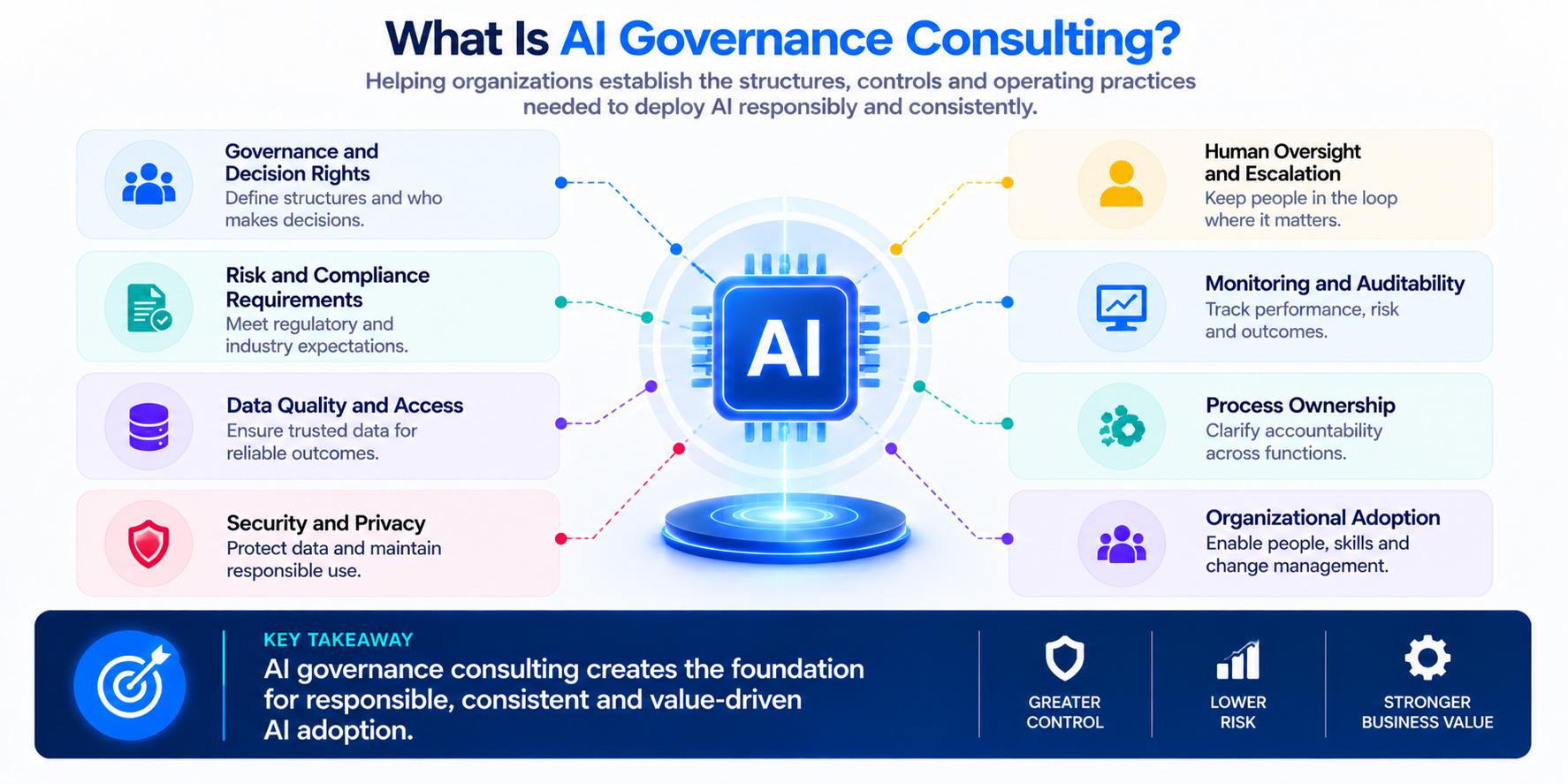
The objective is not simply to create more AI policies. It is to establish an environment in which AI can be implemented with appropriate control while still delivering measurable business value.
Why AI Governance Goes Beyond AI Policy
An organization can have a strong responsible-AI policy and still struggle to scale AI successfully.
Why?
Because AI operates inside existing business processes.
If those processes rely on inconsistent data, unclear ownership, manual workarounds, or decisions that vary by individual or location, AI inherits those conditions.
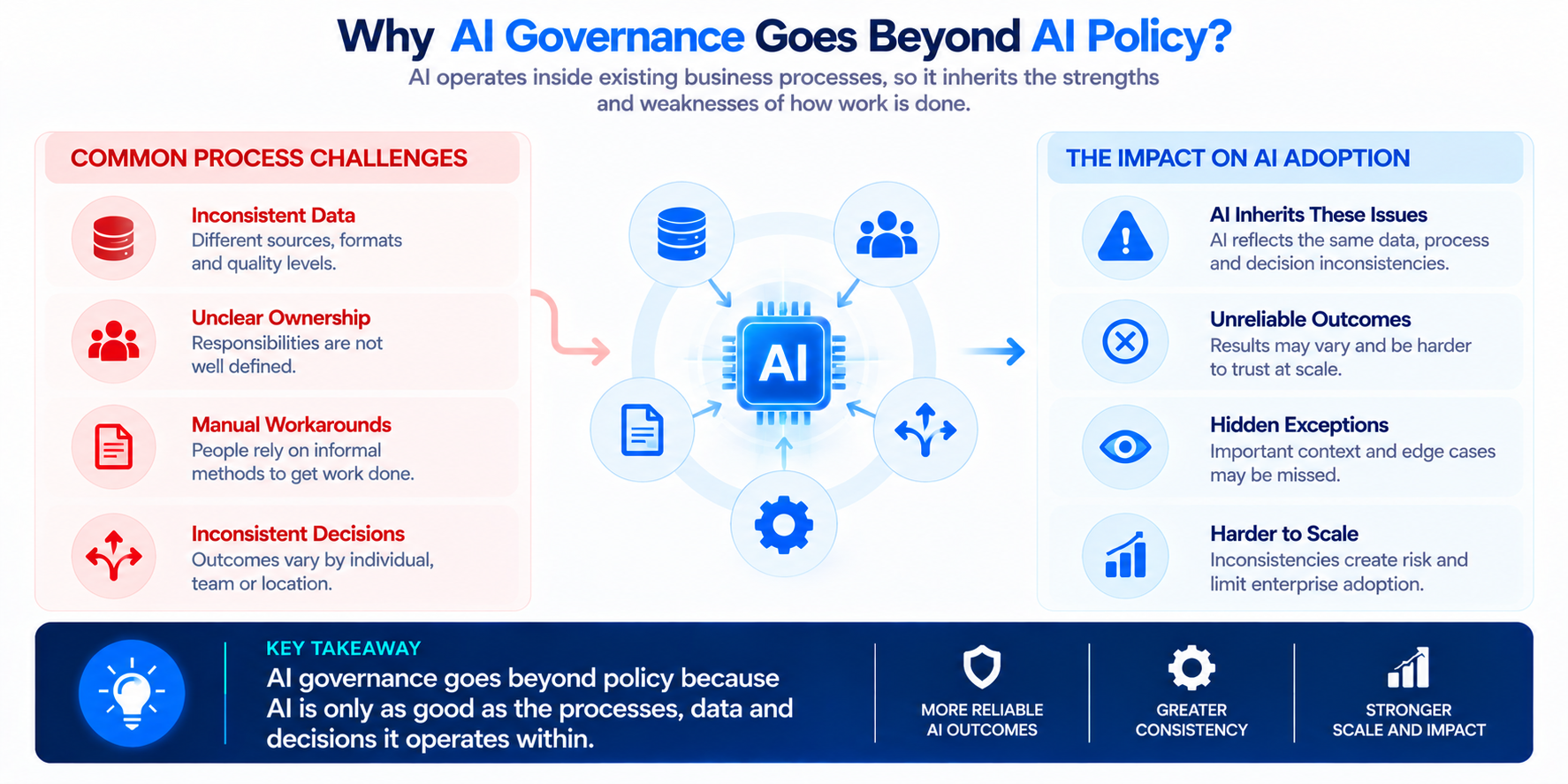
For years, people have often compensated for these inconsistencies. Experienced employees know which information to question, which exception matters, whom to contact, and when a process needs to deviate from the documented path.
AI does not automatically possess that organizational context.
As AI becomes more embedded in enterprise workflows, assumptions that once lived in people’s heads must increasingly become explicit through data standards, business rules, governance, and defined processes.
The Connection Between AI Governance and AI Readiness
AI governance and AI readiness are closely connected, but they are not the same thing.
Governance establishes how AI and the environment around it will be controlled, monitored, and held accountable.
Readiness asks whether the organization has the broader foundation necessary to use AI effectively in the first place.
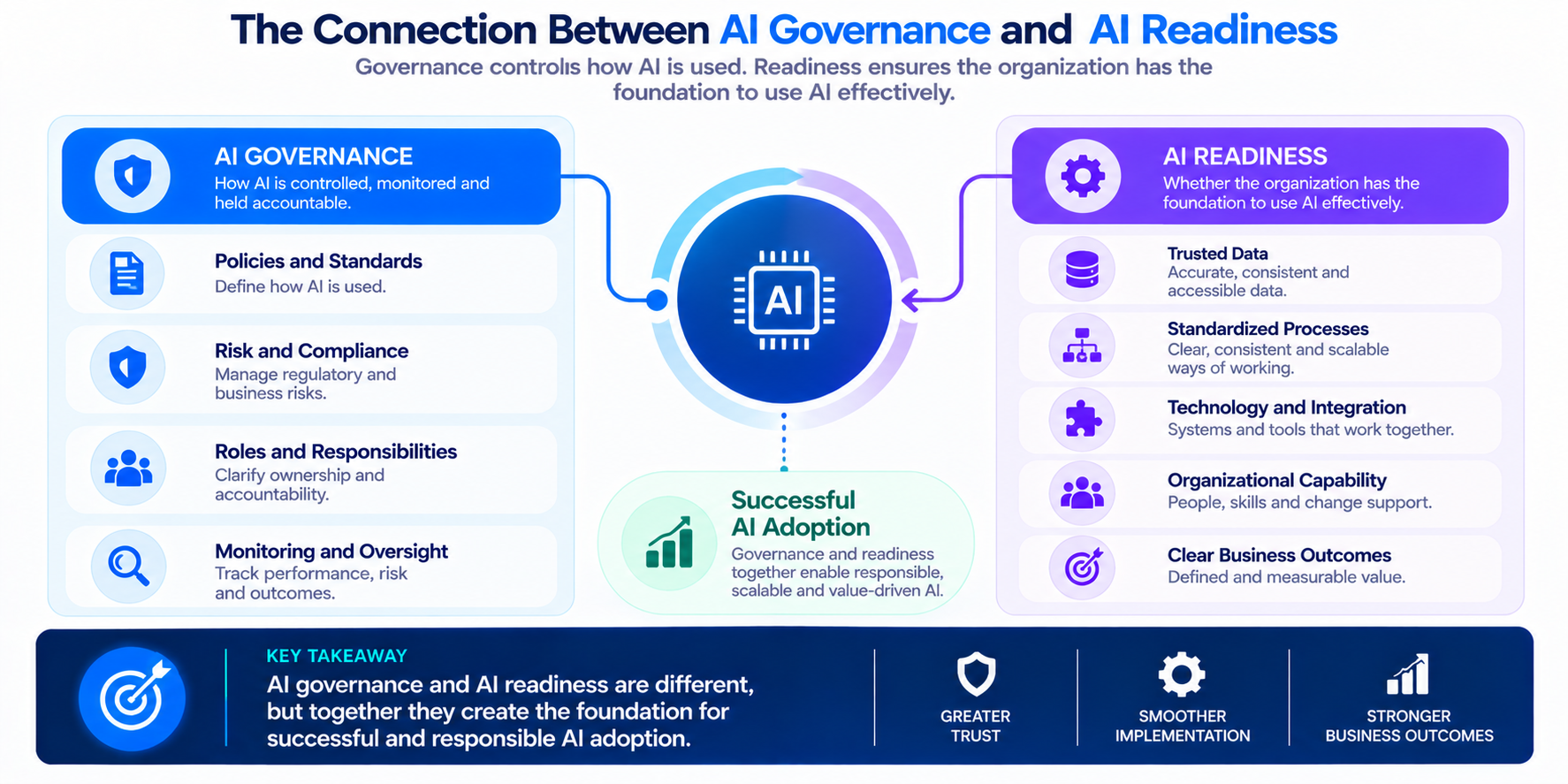
That foundation includes more than technology. It includes trusted data, standardized processes, governance, integration, organizational capability, and clear business outcomes.
An organization may therefore have appropriate AI policies while still not being operationally ready to scale AI.
Governance Should Begin Before AI Scales
Governance is much easier to establish before AI becomes deeply embedded across dozens of processes and use cases.
Organizations should be able to answer fundamental questions such as:
- What business outcome is this AI use case expected to produce?
- Who owns that outcome?
- What data does the AI depend on, and can that data be trusted?
- Which decisions can AI make or support?
- Where is human judgment required?
- How are exceptions handled?
- How will performance, risk, and outcomes be monitored?
- What happens when the process or underlying data changes?
These are not simply technology questions.
They are enterprise execution questions.
From AI Experimentation to Governed Adoption
Successful enterprise AI adoption requires organizations to move beyond isolated experimentation.
That does not mean every AI initiative needs a large governance structure. Governance should be appropriate to the use case, its business impact, and its level of risk.
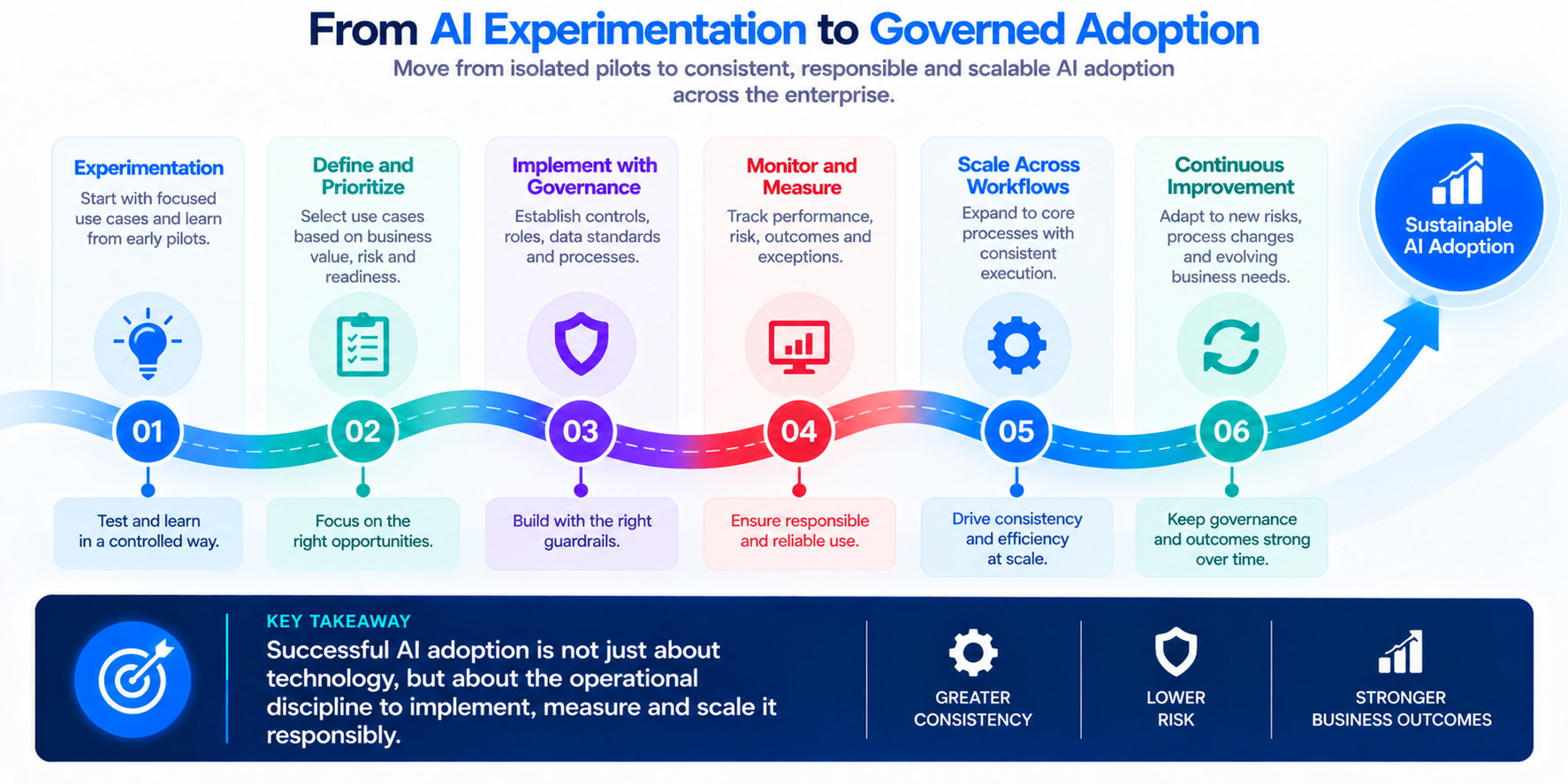
But as AI moves into core workflows and begins influencing decisions, organizations need greater consistency in how use cases are selected, implemented, measured, and governed.
The organizations best positioned to scale AI will not simply be those with the most advanced technology.
They will be those that create the operational discipline necessary for AI to work reliably within the enterprise.
AI cannot fix poor data or inconsistent execution.
Thinking differently precedes doing differently.


Mark Kruckeberg is the Managing Partner of Soltec and a recognized leader in enterprise transformation, operational excellence, governance, and AI readiness. With more than 26 years of experience leading large-scale business, operational, and technology initiatives, Mark has helped organizations improve execution, strengthen governance, optimize workflows, and build trusted data foundations. Today, he works with enterprise leaders to improve operational performance, organizational readiness, and long-term business outcomes while preparing their organizations for successful AI adoption and future innovation.