
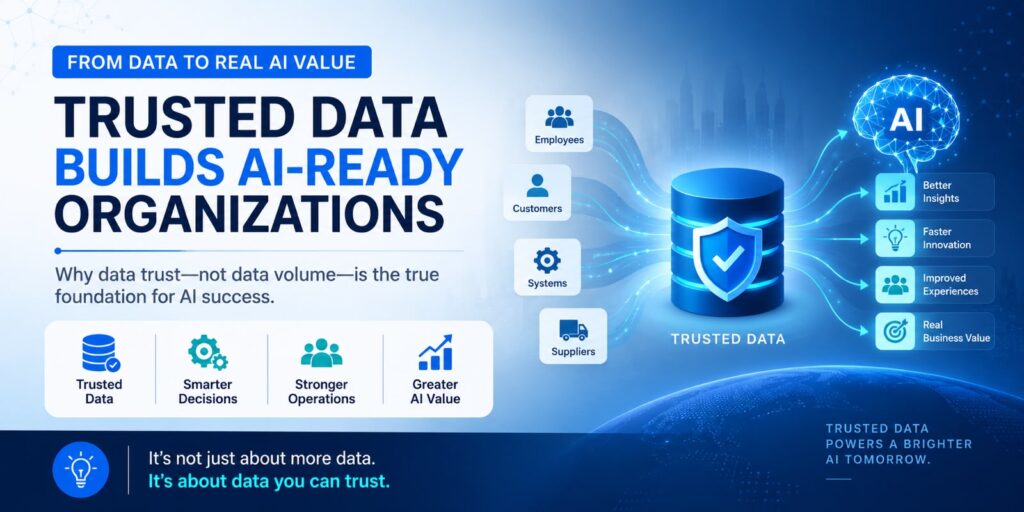
As organizations expand their use of AI, the conversation often turns to data: how much is available, where it resides, and how AI can access more of it. But becoming AI-ready is not simply about giving AI access to more enterprise data. It is about ensuring the information AI relies on is accurate, complete, consistent, accessible, governed, and understood in context.
The more important question for executives is not “Do we have enough data for AI?”
It is “Can AI trust the data our enterprise creates?”
AI Inherits the Data Environment It Enters
Organizations have operated with imperfect data for decades. In many cases, employees have learned how to compensate for it.
They recognize duplicate records. They know which system is usually more reliable. They understand that the same customer, product, supplier, or business term may be defined differently across functions. When information is incomplete or conflicting, experienced employees know who to call, where else to look, or how to reconcile the difference before making a decision.
Those human interventions can make underlying data problems less visible than they really are.
AI changes that equation.
As AI becomes more involved in analysis, recommendations, decisions, and workflow execution, organizations are increasingly asking technology to act on enterprise information with less human interpretation between the data and the outcome.
AI does not automatically know which duplicate record is correct, which system should be trusted, why two definitions differ, or whether missing information represents an error or a legitimate exception. Unless that context is available and governed, AI inherits the same uncertainty the organization has learned to work around.
That is why AI-ready data is not simply about volume or access. It is about whether the enterprise can provide information with enough quality, context, consistency, and governance for AI to use it reliably.
AI doesn’t fix an organization’s data environment. It operates within it.
Clean Data and Trusted Data Are Not the Same Thing
When organizations discuss data quality, the conversation often focuses on the condition of the data itself. Are records complete? Are duplicates being removed? Are formats consistent? Are errors being corrected?

Those efforts matter. Data cleansing, normalization, deduplication, and consolidation can all improve the quality of enterprise information.
But clean data and trusted data are not necessarily the same thing.
A record can appear complete and accurate without providing confidence in how the information was created, validated, or maintained. Different systems may contain equally plausible values. Business units may define the same data differently. Information may be technically correct but lack the operational context needed to determine when or how it should be used.
For AI, those distinctions matter.
Trusted enterprise data requires organizations to understand more than what information they have. They need to understand where critical data originates, who owns it, which business rules govern it, how it is validated, when it changes, and whether its meaning remains consistent as it moves across processes and systems.
This shifts the data-quality conversation from correcting information after problems occur to understanding the conditions that create and maintain reliable information in the first place.
Clean data describes the condition of information. Trusted data reflects confidence in how that information was created and maintained.
Data Quality Begins Where Data Is Created
Many data-quality problems do not begin in databases. They begin in the business processes that create and maintain the data.
Every day, employees, customers, suppliers, systems, and applications create or modify enterprise information as work is performed. Customer records are established, suppliers are onboarded, materials are created, orders are entered, approvals are completed, and transactions move between functions and systems.
The quality of that information is often determined at the moment it enters the enterprise.
If different workflows capture different information, employees interpret requirements differently, validation rules are inconsistent, or manual workarounds bypass established controls, unreliable data can become part of the operational environment before a traditional data-quality process ever encounters it.
Organizations may then invest significant effort downstream cleansing records, resolving duplicates, reconciling systems, and correcting information. Those activities can address the symptoms, but they do not necessarily address the conditions that continue creating the problems.
If the enterprise continually creates unreliable data, cleansing it after the fact becomes an endless cycle.
Creating trusted enterprise data therefore requires looking upstream at the processes and business rules responsible for creating and changing it. Where is information first captured? What validates it? Who determines whether it is correct? What happens when an exception occurs? Can employees bypass required information or controls to keep work moving?
These are operational questions as much as they are data questions.
For AI readiness, that distinction is critical. Improving data quality for AI is not simply an exercise in preparing existing datasets. It requires strengthening the way important information is created, validated, governed, and maintained through everyday execution.
Trusted data begins at the source—not with the cleanup that happens afterward.
Governance Turns Data Quality Into an Operating Discipline
Creating trusted data at the source requires more than validation rules and technology. It requires clarity about who is responsible for the information and how it should be managed throughout its lifecycle.
In many enterprises, data crosses organizational boundaries constantly. Customer information may originate in one function and be used by several others. Supplier or product data may move through procurement, operations, finance, logistics, and multiple enterprise systems. Each interaction creates an opportunity for information to be interpreted, changed, supplemented, or duplicated.
Without clear governance, responsibility can become fragmented. Different functions may apply different definitions, validation requirements, or business rules to the same information. Employees may know how their part of the process works without understanding how decisions made upstream affect the people and systems that depend on the data downstream.
Governance helps establish that clarity.
Who owns critical information? What does a particular data element mean? Which business rules determine whether it is valid? Who has authority to change it? How are exceptions handled? What happens when information moves between systems or business functions?
For AI, these questions become increasingly important because trusted data depends on more than technical accuracy. AI also needs sufficient context to understand what information represents and how it should be used.
Governance provides the structure for that confidence, but policies and definitions alone are not enough. Those standards must also be reflected in the processes where information is created, validated, changed, and consumed.
Data governance defines what the enterprise intends to trust. Operational execution determines whether it actually can.
That is what turns data quality from a periodic cleanup exercise into an ongoing operating discipline.
AI Raises the Cost of Untrusted Data
Poor data quality has always carried a cost.
Employees spend time reconciling conflicting information, correcting errors, searching for missing data, and determining which source is reliable. Decisions are delayed. Reports require manual validation. Transactions are interrupted. Customers and suppliers may be asked to provide information the organization should already have.
For years, much of that cost has been absorbed through human effort.
AI changes both the speed and scale at which unreliable information can affect the enterprise.
As organizations use AI to generate recommendations, support decisions, initiate actions, and participate in workflow execution, the quality and context of the underlying data become increasingly consequential. An employee who encounters conflicting information may recognize that something looks wrong and investigate further. An AI-supported process can only make that distinction when the necessary context, rules, and controls are available to it.
The concern is not simply that poor data may produce an incorrect answer. Untrusted data can influence decisions and actions across connected processes, potentially extending an inconsistency beyond the point where it originated.
This is why data quality for AI cannot be separated from the operational environment that produces the data. Organizations need confidence not only that critical information is accurate at a particular moment, but that the processes and governance surrounding it can continue to maintain that reliability as the business changes.
AI can scale the consequences of information the organization could not reliably trust in the first place.
Research Insight
McKinsey reports that while nearly two-thirds of enterprises have experimented with AI agents, fewer than 10% have scaled them to deliver tangible value. Eight in ten companies cite data limitations as a roadblock to scaling agentic AI, reinforcing the importance of strong data foundations as organizations move from AI experimentation to enterprise execution.
Source: McKinsey & Company, “Building the Foundations for Agentic AI at Scale,” April 2026.
The more responsibility organizations give AI, the more important that confidence becomes.
The Benefits Begin Before AI
Improving enterprise data is often positioned as preparation for AI. But organizations do not need to wait for AI to realize the value of trusted data.
When employees spend less time correcting records, reconciling conflicting information, searching across systems, or determining which source is accurate, the benefits are immediate. Work moves faster. Decisions can be made with greater confidence. Errors and rework can decline. Controls can become more effective because the information moving through business processes is more reliable.
Trusted data can also increase the value of technology investments organizations have already made.

ERP, CRM, analytics, automation, reporting, and other enterprise platforms all depend on the quality of the information flowing through them. When that information is inconsistent or incomplete, organizations often compensate through spreadsheets, manual reconciliation, additional controls, and employee intervention. Improving the data—and the processes responsible for creating it—can reduce those workarounds while helping existing systems perform closer to their intended potential.
This changes the business case for AI data readiness.
Strengthening enterprise data should not be viewed simply as a prerequisite or additional cost that must be absorbed before AI can deliver value. It is an opportunity to improve how the enterprise operates today while creating a more reliable foundation for AI tomorrow.
The value of AI-ready data does not have to wait for AI.
Building Trusted Data at the Source
Organizations do not need perfect data everywhere before they can pursue AI. Trying to cleanse, standardize, and govern every piece of enterprise information before moving forward would be neither practical nor necessary.
A more useful starting point is the business outcome AI is expected to support.
What information does that outcome depend on? Where is the data created? Which processes modify it? Who owns it? What business rules determine whether it is valid? Where is it manually reconciled? Which systems disagree? Where do employees hesitate because they are not confident the information is correct?
Those questions help organizations focus their AI data readiness efforts where reliability matters most.
They can also expose problems that traditional data-quality initiatives may overlook. A recurring data issue may actually originate in an inconsistent workflow. Duplicate records may result from unclear ownership. Missing information may reflect a process that allows work to continue without required data. Conflicting values across systems may reveal that the enterprise has never established which source should govern a particular decision.

Addressing those conditions creates something more durable than a cleaner dataset. It strengthens the operational environment responsible for maintaining trusted information over time.
That is the distinction executives should keep in mind as organizations expand their use of AI. The objective is not simply to prepare data so AI can consume it. It is to create greater confidence that the enterprise can continue producing and maintaining information AI can rely on.
Before giving AI access to more data, organizations should be confident they can trust the data they already have.
Frequently Asked Questions About AI-Ready Data
Understanding what makes enterprise data ready for AI and how data quality, governance, and operational execution influence whether AI can use that information reliably.
What is AI-ready data?
AI-ready data is enterprise information that is sufficiently accurate, complete, consistent, accessible, governed, and understood in context for AI to use reliably.
Being AI-ready does not mean every piece of organizational data must be perfect. What matters is whether the information required for a particular AI use case or business outcome can be trusted. That requires understanding where critical data originates, how it is validated and maintained, who owns it, and which business rules govern how it should be used.
What makes enterprise data ready for AI?
Enterprise data becomes more ready for AI when organizations can establish confidence in both the information itself and the operational environment responsible for creating and maintaining it.
That includes data quality, consistent definitions, appropriate access, clear ownership, governance, validation rules, and sufficient business context. It also requires understanding the processes that create and change critical information. Clean records alone may not be enough if inconsistent workflows, unclear ownership, or unmanaged exceptions continue producing unreliable data.
Why does AI need trusted enterprise data?
AI relies on enterprise data to generate insights, make recommendations, support decisions, and increasingly participate in workflow execution. When that information is incomplete, inconsistent, or lacks context, AI inherits the same uncertainty employees have historically resolved through experience and judgment.
Trusted enterprise data provides greater confidence that AI is operating with information the organization understands and intends to use. As AI assumes greater responsibility within business processes, the reliability of the underlying data becomes increasingly important.
How does data governance support AI readiness?
Data governance establishes ownership, definitions, business rules, decision authority, validation requirements, and accountability for important enterprise information.
For AI readiness, governance helps organizations understand what critical data means, who is responsible for it, how it should be maintained, and under what conditions it can be trusted. Governance becomes most effective when those standards are reflected in the operational processes where data is actually created, changed, and consumed—not simply documented as policies.
How do business processes affect the quality of data used by AI?
Many data-quality problems originate in business processes rather than databases. Different workflows may capture information differently, employees may interpret requirements inconsistently, manual workarounds may bypass validation, and exceptions may allow incomplete or conflicting information to enter enterprise systems.
Those conditions affect the data AI eventually uses. Improving data quality for AI therefore requires looking upstream at how critical information is created and maintained, not only cleansing or correcting it after problems appear.
Does having more data make an organization more AI-ready?
Not necessarily. Having large volumes of enterprise data can create more opportunities for AI, but volume alone does not make that information reliable or useful.
AI readiness depends on whether the data relevant to a particular business outcome is accurate enough, sufficiently complete, consistently understood, appropriately governed, and available with the context AI needs to use it. For many organizations, strengthening the reliability of critical existing data may be more valuable than simply giving AI access to more information.


Mark Kruckeberg is the Managing Partner of Soltec and a recognized leader in enterprise transformation, operational excellence, governance, and AI readiness. With more than 26 years of experience leading large-scale business, operational, and technology initiatives, Mark has helped organizations improve execution, strengthen governance, optimize workflows, and build trusted data foundations. Today, he works with enterprise leaders to improve operational performance, organizational readiness, and long-term business outcomes while preparing their organizations for successful AI adoption and future innovation.