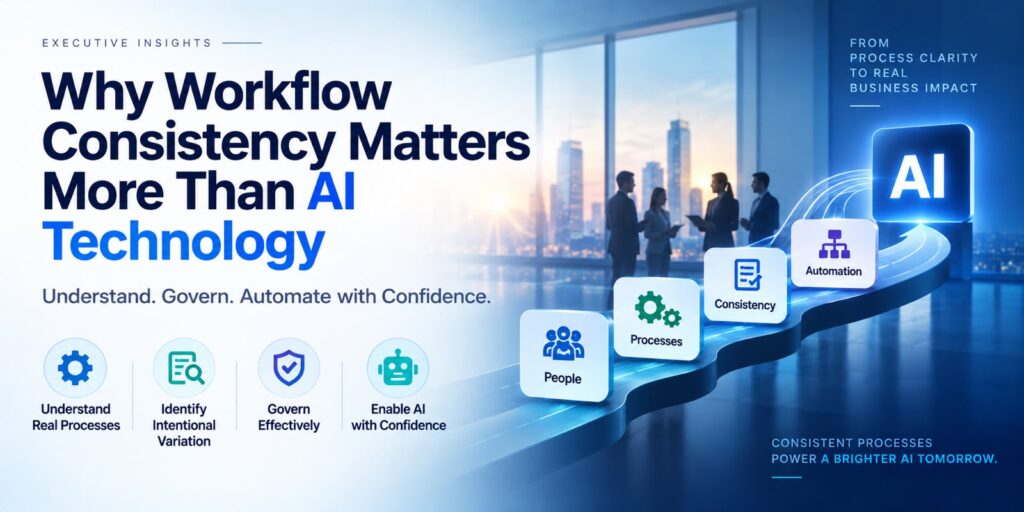
As organizations expand workflow automation and introduce AI into more areas of the enterprise, the consistency of the processes behind that technology becomes increasingly important. Before automating more work, leaders need to understand how work is actually being performed—and whether the variations across the enterprise are intentional, understood, and governed.
AI Changes the Consequences of Process Variation
Organizations have always had process variation. Different business units, locations, markets, customers, and regulatory environments often require work to be performed differently. That variation is not inherently a problem.
The challenge is that many organizations do not fully understand where those differences exist or why. Over time, documented processes are supplemented by local practices, manual workarounds, spreadsheets, email handoffs, institutional knowledge, and exceptions that become part of how work actually gets done.
For years, people have compensated for this complexity. Experienced employees know which exception applies, who needs to approve something, where to find missing information, or how to navigate a process when reality does not match the documented workflow.
AI changes that equation.
As organizations introduce AI into business processes, the ability to rely on human judgment to continuously reconcile inconsistencies becomes less sustainable. AI increasingly depends on clear business rules, reliable operational context, and workflows that behave predictably enough for technology to act with confidence.
This does not mean every process must be standardized.
AI doesn’t require every process to be the same. It requires the differences to be understood, intentional, and governed.
And that creates a different question for executives considering AI: Do we understand how work is actually being performed across the enterprise well enough to automate or augment it?
Not All Process Variation Is a Problem
Process consistency is often interpreted as standardization: one process, performed the same way, everywhere. In a complex enterprise, that is rarely practical—and it may not even be desirable.
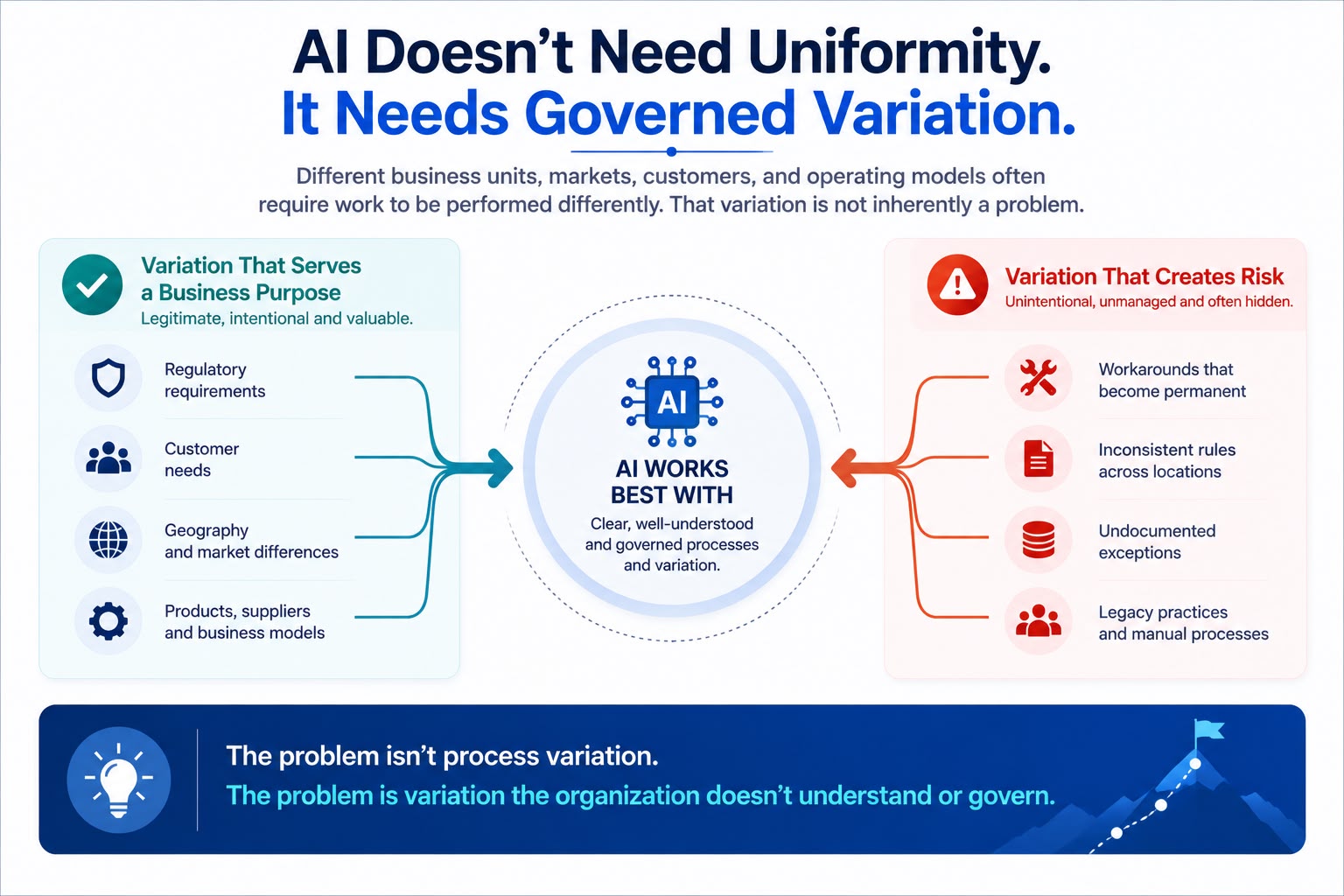
A manufacturing facility may operate differently because of local regulatory requirements. A business unit may serve customers with unique contractual obligations. Different markets, products, suppliers, or operating models may legitimately require different workflows. These variations can be an important part of how the business operates effectively.
The greater concern is operational drift—variation that develops without deliberate design or governance.
A workaround introduced to solve a temporary problem becomes permanent. An approval step is interpreted differently across locations. A spreadsheet is created because an existing system does not support a particular need. Employees develop their own ways of handling exceptions that eventually become embedded in daily operations.
Eventually, the organization may have multiple versions of the same process without clearly understanding why they differ.
That distinction becomes increasingly important as AI is introduced into workflows. Before deciding what should be standardized, automated, or AI-enabled, organizations need to distinguish between variation that serves a legitimate business purpose and variation that simply accumulated over time.
The problem isn’t process variation. The problem is variation the organization doesn’t understand or govern.
When the Documented Process Isn’t the Actual Process
One of the greatest challenges for enterprise leaders is that the process they believe exists may not be the process employees actually follow.
A documented workflow might show a straightforward sequence of activities, approvals, and decisions. In practice, employees may rely on spreadsheets to track information, email to obtain approvals, manual data entry between systems, or institutional knowledge to determine what happens next. Exceptions that appear uncommon on paper may actually be part of everyday execution.
These workarounds often exist for good reasons. Employees create them to keep work moving when systems, processes, or business rules do not fully reflect operational reality. The problem arises when those workarounds become embedded in execution without being visible or governed.
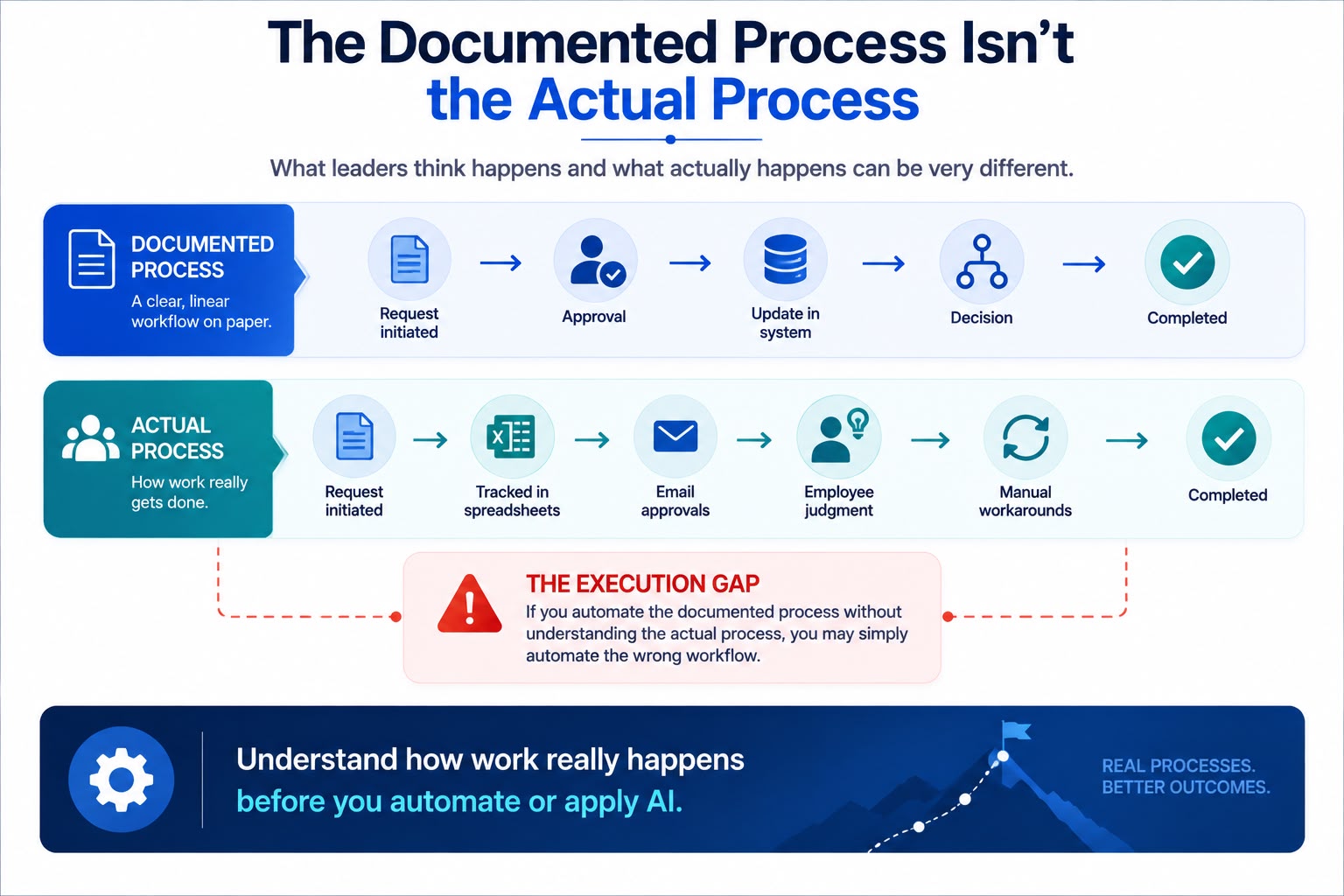
This creates a particular challenge for workflow automation and AI. Technology operates against the processes, data, and rules available to it. It may not recognize the unwritten knowledge employees use to resolve an exception or understand why a particular step is routinely performed differently.
Automating the documented workflow without understanding the actual workflow can therefore create a false sense of improvement. The process may move faster, but the underlying inconsistencies remain—or become more difficult to manage at scale.
Before organizations automate more of their work, they need visibility into how that work is actually being performed.
Why AI Raises the Stakes
Process inconsistency is not new. Organizations have managed it for decades because people are remarkably effective at filling the gaps between systems, processes, and business rules.
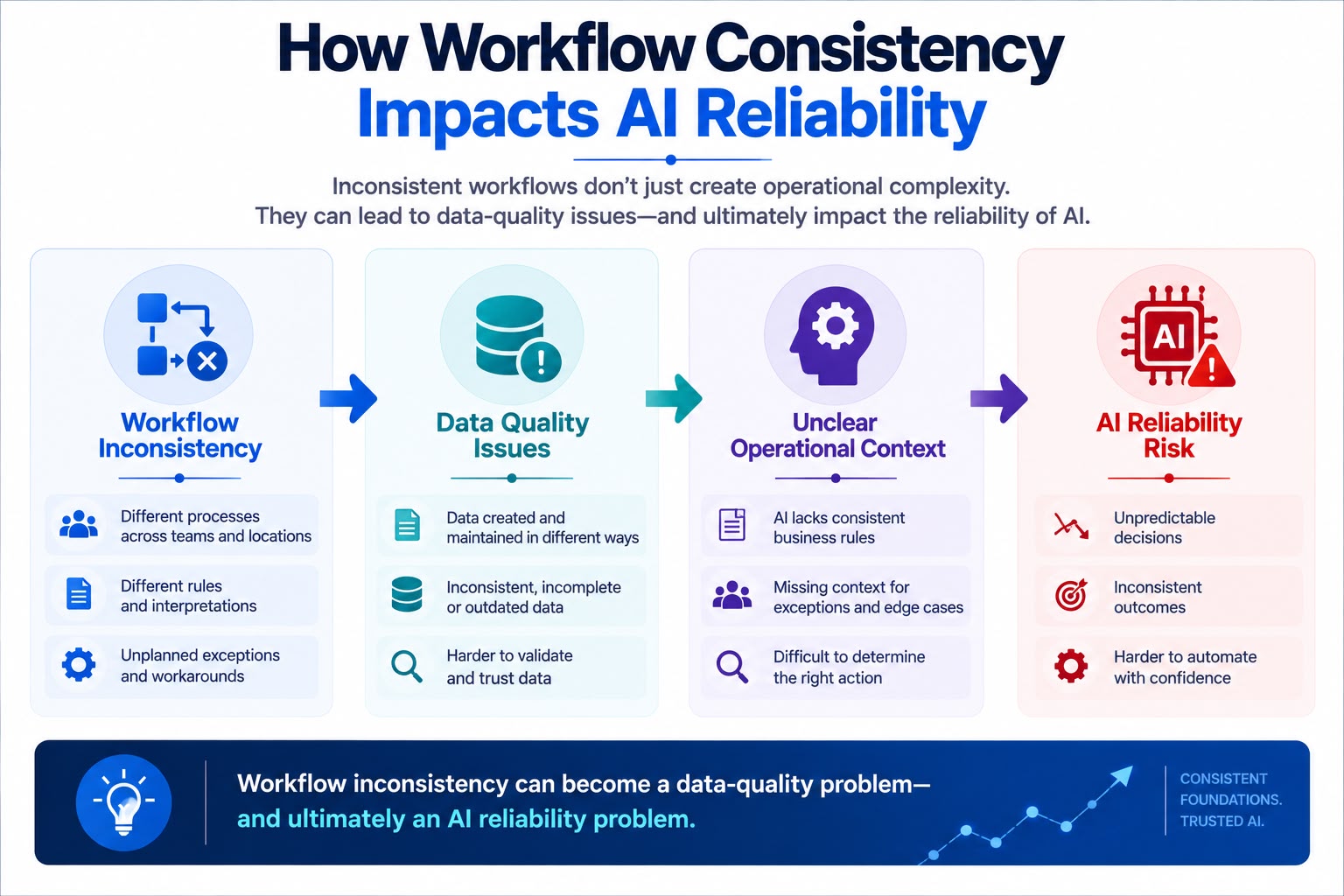
AI changes the consequences of those inconsistencies.
As AI becomes more involved in operational decisions and workflow execution, it increasingly depends on clear rules, reliable data, consistent context, and defined decision authority. When those conditions are unclear, AI does not automatically resolve the ambiguity. It operates within it.
Consider a process where different business units apply the same approval policy differently. Employees may understand those differences because they know the customer, location, history, or unwritten rules behind the decision. An AI-supported workflow needs that context to be explicit enough to determine which rule applies and when an exception is appropriate.
The same issue extends to data. When processes are performed differently, they often create, validate, and maintain information differently as well. What begins as workflow inconsistency can quickly become a data-quality problem—and ultimately an AI reliability problem.
This is why workflow consistency is an AI Readiness issue, not simply a process optimization issue.
Research Insight
McKinsey’s global research on AI adoption reinforces the connection between workflow design and business value. Among 25 organizational attributes studied, redesigning workflows had the greatest impact on an organization’s ability to realize EBIT value from generative AI. Yet only 21% of respondents whose organizations were using generative AI reported that they had fundamentally redesigned at least some workflows.
Source: McKinsey & Company, “The State of AI: How Organizations Are Rewiring to Capture Value,” March 2025.
Organizations do not need to eliminate every variation before adopting AI. But they do need enough visibility and governance to ensure that AI is operating within processes the organization understands and business rules it intends to enforce.
AI can accelerate execution. The question is whether the enterprise is confident in what it is accelerating.
The Goal Is Governed Variation, Not Uniformity
The answer to workflow inconsistency is not to force every part of the enterprise into a single way of working.
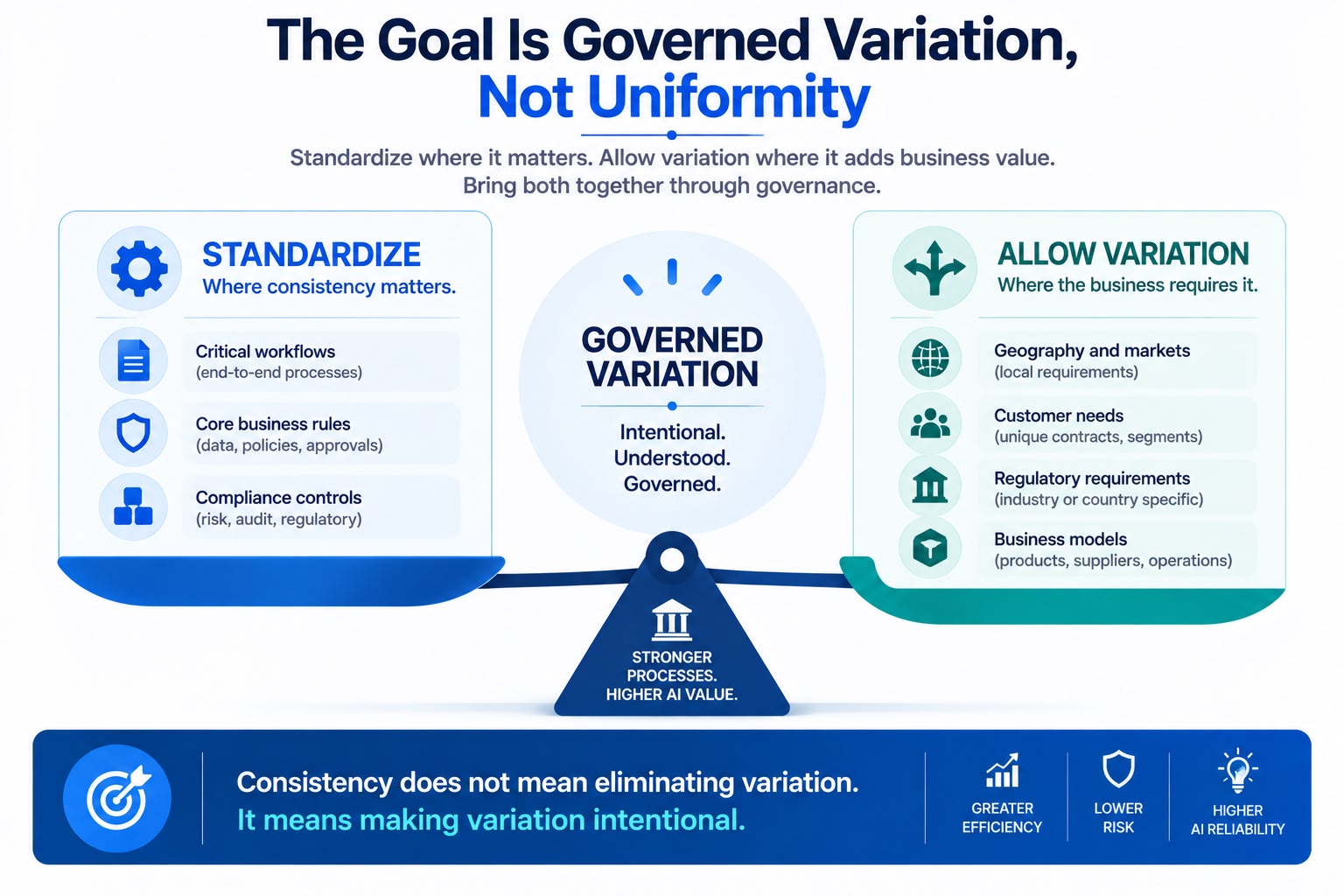
The better objective is governed variation: establishing consistency where it matters while allowing legitimate differences where the business requires them.
That begins with understanding which processes and business rules require consistent execution. Some may need to operate the same way across the enterprise. Others may appropriately vary by geography, business unit, customer, product, regulatory requirement, or operating model. What matters is that those differences are intentional, understood, and governed.
For executives, this creates a practical set of questions:
- Which workflows require enterprise-wide consistency?
- Where is variation necessary, and why?
- Who determines when an exception is appropriate?
- Are business rules interpreted and applied consistently?
- Can we see how work is actually being performed across functions and systems?
- Are exceptions governed, or have they simply become accepted ways of working?
Workflow governance, process optimization, workflow automation, and workflow orchestration can all play a role. But technology should support the operating model the organization intends to execute—not define it by default.
This distinction becomes especially important with AI. Organizations that understand where consistency matters, where variation is necessary, and how exceptions should be handled are better positioned to introduce AI without sacrificing the flexibility their businesses require.
Consistency does not mean eliminating variation. It means making variation intentional.
The Benefits Begin Before AI
Improving workflow consistency is often discussed as preparation for AI, but the business value begins much earlier.
When organizations understand how work is actually performed, they can identify unnecessary process variation, redundant steps, recurring exceptions, manual handoffs, and workarounds that create cost and complexity. Addressing those issues can reduce rework, shorten cycle times, improve productivity, strengthen controls, and create more consistent customer and employee experiences.
It can also improve the value organizations receive from technology investments they have already made. Enterprise systems are often capable of supporting more consistent execution, but their effectiveness is limited when processes continue to operate differently around them through spreadsheets, email, manual intervention, and institutional knowledge.
This changes the business case for AI Readiness. Improving workflows should not be viewed simply as an investment required before an organization can pursue AI. It is an opportunity to improve how the enterprise operates today while creating stronger conditions for automation and AI tomorrow.
The value of becoming AI-ready does not have to wait for AI.
Understand Execution Before You Automate It
AI will continue to expand the opportunities organizations have to automate decisions, workflows, and increasingly complex areas of enterprise execution. But the ability to automate more does not necessarily mean an organization is prepared to do so.
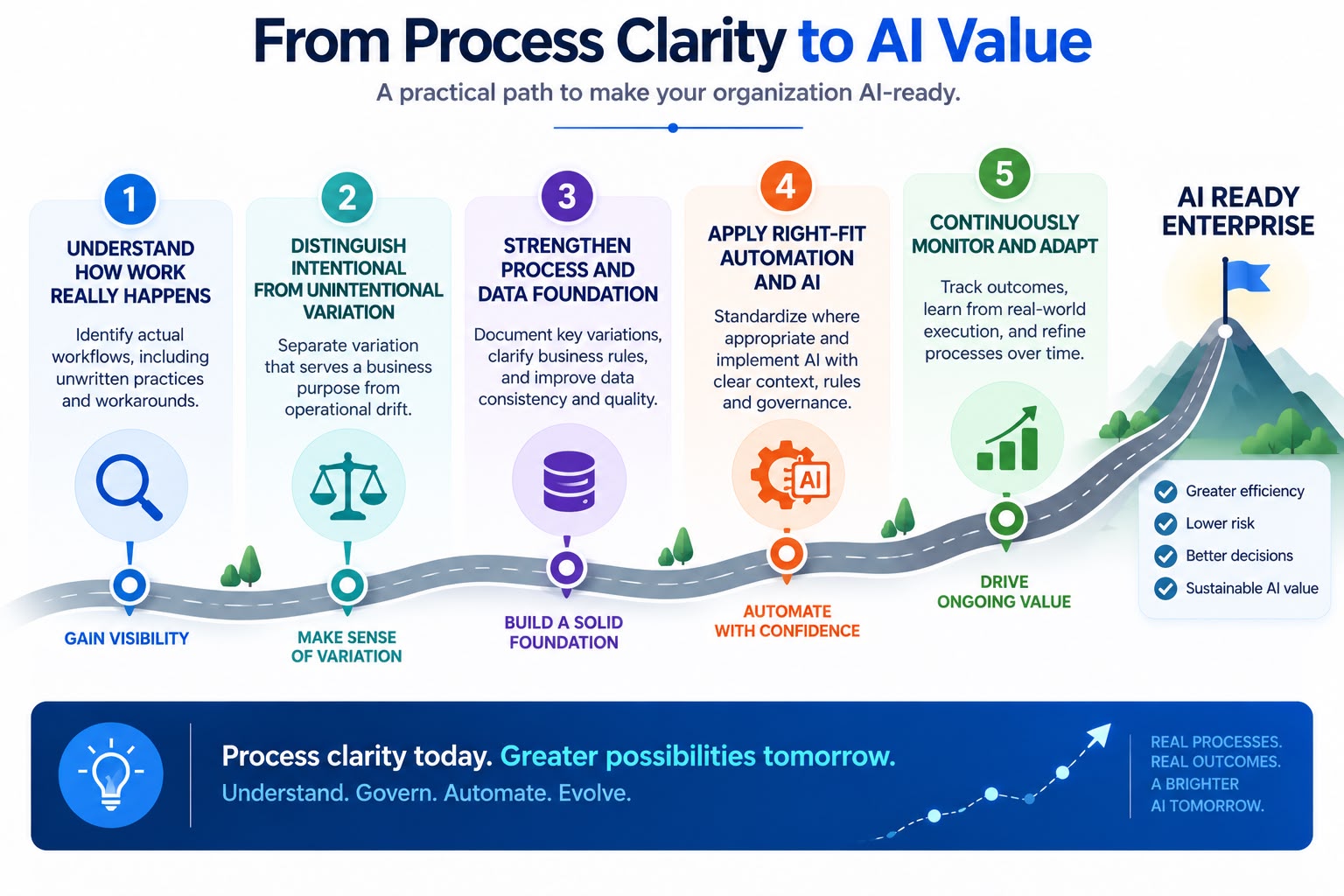
Before deciding where AI should be introduced, leaders need a clear understanding of how critical work is actually being performed. Where does execution differ from the documented process? Which variations serve a legitimate business purpose? Which developed through operational drift? Where are employees compensating for gaps between systems, processes, and business rules?
Answering those questions can create value regardless of how quickly an organization adopts AI. It can expose opportunities to simplify work, strengthen governance, improve data quality, reduce unnecessary complexity, and get more value from existing technology—while creating a stronger foundation for AI.
The objective is not to make every process identical. It is to create enough visibility, consistency, and governance that the organization—and ultimately AI—can understand how work is intended to be performed.
Before asking where AI can automate work, organizations should understand the work AI is being asked to automate.
Frequently Asked Questions About Workflow Consistency and AI
Understanding how workflow consistency, process variation, and governance influence an organization’s ability to adopt AI successfully.
Does AI require standardized business processes?
No. AI does not require every business process to be performed identically across an enterprise. Different locations, business units, customers, products, and regulatory environments may legitimately require different ways of working.
What matters is whether those differences are intentional, understood, and governed. Organizations should establish consistency where it is necessary while allowing appropriate variation where the business requires it. The greater risk for AI is uncontrolled variation—when processes differ because of undocumented workarounds, inconsistent business rules, or operational practices the organization does not fully understand.
Why is workflow consistency important for AI adoption?
AI increasingly depends on clear business rules, reliable operational context, trusted data, and predictable workflows. When work is performed inconsistently, AI may encounter the same ambiguity employees have historically resolved through experience, judgment, and institutional knowledge.
Improving workflow consistency helps make those rules, decisions, and exceptions more explicit. This creates a stronger operational foundation for AI while also helping organizations identify inefficiencies, unnecessary complexity, and opportunities to improve execution before AI is introduced.
How does inconsistent workflow execution affect AI implementation?
Inconsistent workflow execution can make it difficult for AI to determine which process, business rule, or decision path should apply in a particular situation.
It can also contribute to inconsistent data because different processes may create, validate, and maintain information differently. When organizations automate or introduce AI without understanding these variations, technology can accelerate existing inconsistencies rather than resolve them. Greater visibility into how work is actually performed helps organizations determine what should be standardized, what should remain flexible, and where stronger governance is needed.
How can enterprises distinguish necessary process variation from operational drift?
Necessary variation exists for a legitimate business reason, such as regulatory requirements, customer obligations, geographic differences, product requirements, or operating models. Operational drift develops over time without deliberate design or governance.
Leaders can distinguish between the two by examining how critical workflows are actually performed and asking why differences exist. If a variation serves a defined business requirement, it may need to remain. If it exists because of a temporary workaround, inconsistent interpretation, undocumented exception, or legacy practice, it may represent an opportunity to simplify or improve the process.
How can workflow governance improve the reliability of AI-supported outcomes?
Workflow governance establishes greater clarity around how work should be performed, which business rules apply, who has decision authority, and when exceptions are appropriate.
For AI-supported workflows, that clarity provides more reliable operational context for automated actions and decisions. Governance does not mean eliminating flexibility. It means ensuring that both standard processes and legitimate exceptions operate within boundaries the organization understands and intends to enforce. That can improve execution today while creating stronger conditions for reliable AI adoption.

Mark Kruckeberg is the Managing Partner of Soltec and a recognized leader in enterprise transformation, operational excellence, governance, and AI readiness. With more than 26 years of experience leading large-scale business, operational, and technology initiatives, Mark has helped organizations improve execution, strengthen governance, optimize workflows, and build trusted data foundations. Today, he works with enterprise leaders to improve operational performance, organizational readiness, and long-term business outcomes while preparing their organizations for successful AI adoption and future innovation.