
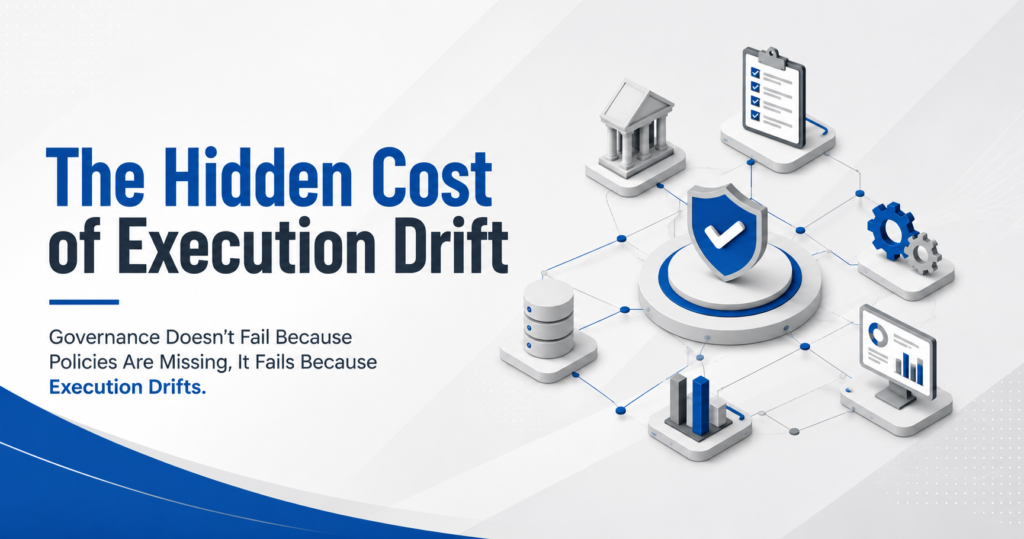
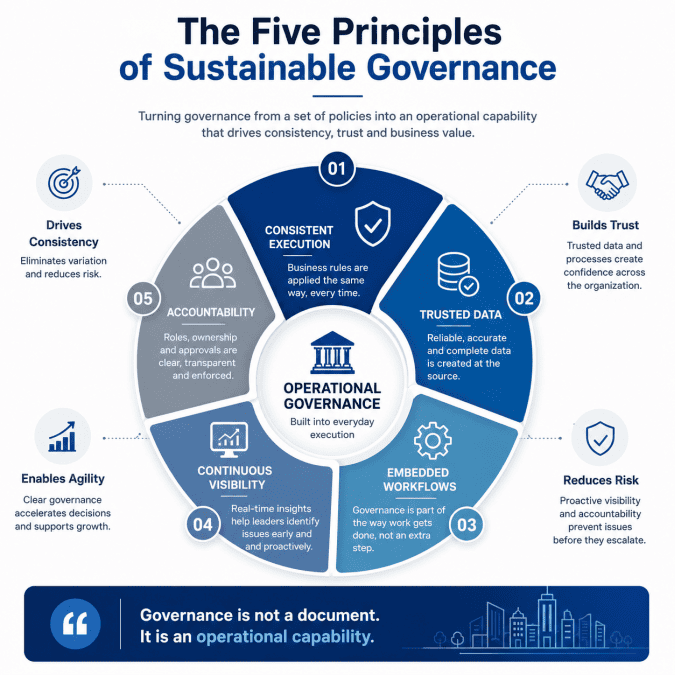
Governance is often discussed in terms of policies, compliance, and risk management. Yet organizations rarely lose governance because documentation is missing—they lose it as everyday execution gradually drifts over time. This article explores why governance must become an operational capability that strengthens execution, trusted data, and AI Readiness.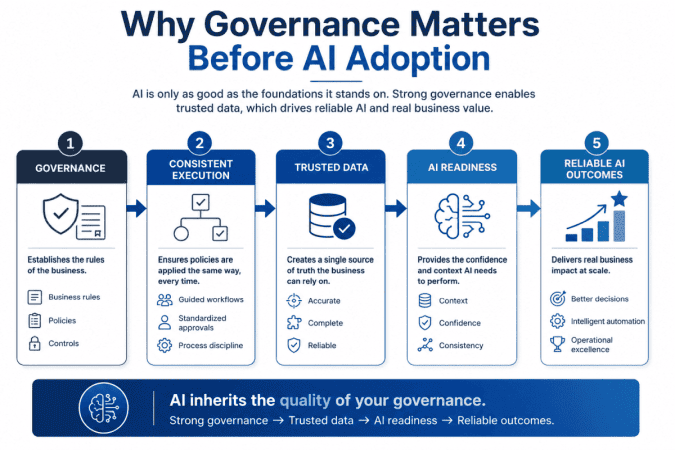
The objective is not to eliminate policies, procedures, or compliance activities. Those remain essential components of effective governance. The goal is to reinforce them through consistent operational execution so that governance becomes sustainable rather than reactive. 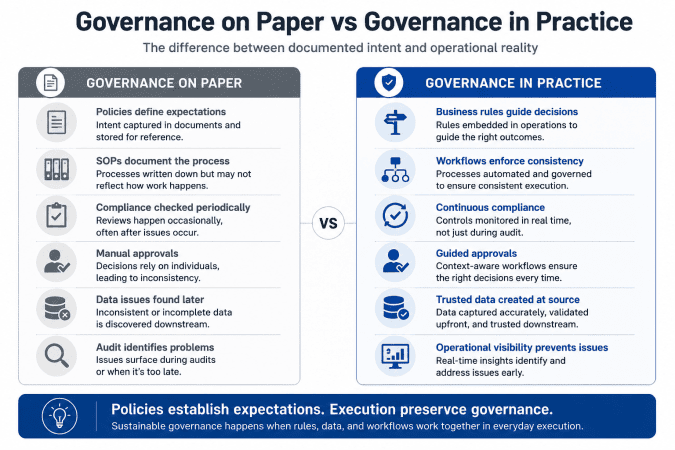
Introduction
Governance is often viewed as a collection of policies, procedures, compliance requirements, and oversight activities designed to reduce organizational risk. Yet many organizations with mature governance programs continue to struggle with inconsistent execution, poor data quality, audit findings, and operational inefficiencies. The challenge is rarely that governance is missing. More often, governance gradually weakens as operational execution drifts over time. Processes evolve. Business priorities change. Teams develop workarounds. Manual steps are introduced. Exceptions become routine. Individually, these changes often make perfect business sense. Collectively, they create a growing gap between how the organization believes work is performed and how work is actually performed. This distinction matters because governance is ultimately measured by the consistency of everyday execution—not by the quality of the policies stored on a shared drive. Organizations that sustain strong governance don’t simply document how work should happen. They embed governance into everyday execution, where work is performed, decisions are made, and trusted data is created.What Is Governance Really Trying to Achieve?
Governance exists to ensure that work is performed consistently, decisions are made appropriately, and trusted data is created throughout the organization. Its purpose is not simply to document how work should happen, but to help ensure that work is performed that way every day. Many organizations associate governance with policies, compliance programs, audit requirements, or risk management. While these are important components of governance, they are not its primary objective. Governance exists to create consistency across the enterprise so that people, processes, systems, and data work together in a predictable, controlled, and measurable way. When governance is effective, employees understand how decisions should be made, business rules are applied consistently, approvals follow established processes, and data is created and maintained according to agreed standards. Leaders gain greater visibility into operational performance because execution is consistent rather than dependent upon individual experience or institutional knowledge. In other words, governance is not an administrative function operating alongside the business. It is an operational capability that enables the business to execute consistently while reducing risk, improving data quality, and strengthening organizational alignment.Why Does Governance Drift Over Time?
Governance rarely fails overnight. More often, it gradually weakens as organizations evolve, priorities shift, and everyday execution begins to diverge from established processes. Most organizations don’t intentionally abandon governance. In fact, many continue investing in governance programs, compliance initiatives, and risk management activities for years. Yet despite those investments, execution often becomes less consistent over time. The reason is simple: businesses are constantly changing. Organizations acquire new companies. Business processes evolve. New technologies are introduced. Regulations change. Teams reorganize. Experienced employees retire. New employees develop different ways of working. Temporary workarounds become permanent practices. Manual spreadsheets fill operational gaps. Exceptions that were once uncommon become part of everyday execution. Individually, each of these changes often makes sense. Together, they gradually create operational drift. As execution drifts, governance becomes increasingly difficult to sustain. Business rules are applied inconsistently. Similar work is performed differently across departments. Data is created using different standards. Leaders lose visibility into how work is actually being performed, making governance more difficult to monitor and enforce.Measured Business Outcomes
Based on approved Manch Technologies customer implementations, organizations that embedded governance into everyday operations demonstrated measurable business improvements beyond compliance alone, including:- Business partner onboarding reduced from 7–10 days to 2 days
- Validation effort reduced by more than 90%
- Governed workflows expanded from a single business process to more than 25 operational workflows
Why Is Governance More Than Policies?
Policies establish expectations. Governance ensures those expectations are carried out consistently through everyday execution. Without consistent execution, even the best policies gradually lose their effectiveness. Most organizations have no shortage of documented policies, procedures, and operating standards. Defining how work should be performed is rarely the challenge. Sustaining that consistency as the organization evolves is. When governance relies primarily on documentation, it becomes increasingly difficult to maintain consistency. Employees develop workarounds to solve immediate business needs. Different departments interpret policies differently. Manual approvals bypass established processes. Local practices emerge that differ from enterprise standards. Over time, the documented process and the operational reality begin to diverge. This is why governance should not be viewed as a periodic compliance exercise. It should be viewed as an operational discipline that supports the way work is performed every day. The strongest governance programs don’t simply define business rules—they embed those rules into operational workflows, approval processes, and decision-making so that governance becomes part of execution rather than an activity performed outside of it.How Does Operational Execution Impact Governance?
Operational execution is where governance either succeeds or fails. Governance becomes sustainable when business rules, approvals, workflows, and data standards are consistently applied as work is performed—not after the fact through audits or corrective actions. Every business process creates decisions. Customer records are established. Suppliers are onboarded. Products are introduced. Contracts are approved. Financial transactions are processed. Each of these activities represents an opportunity to either strengthen governance through consistent execution or introduce additional variability into the organization. When operational execution is governed, business rules are applied consistently, approvals follow established workflows, exceptions are visible, and trusted data is created at the point of execution. Leaders gain confidence that work is being performed according to enterprise standards because governance is embedded directly into the process rather than evaluated only after the work has been completed. When operational execution is inconsistent, governance becomes increasingly reactive. Teams spend more time identifying exceptions, correcting data, reconciling differences between systems, and responding to audit findings than preventing those issues from occurring in the first place. Embedding governance into operational execution shifts the organization’s focus from detecting problems after they occur to preventing them through consistent business practices.Measured Operational Outcomes
Based on approved Manch Technologies customer implementations, organizations that embedded governance into everyday business operations rather than relying solely on downstream controls demonstrated measurable improvements in both operational performance and data quality, including:- Material master creation reduced from approximately one week to three hours
- Time-to-first-order reduced from 20–25 days to approximately 30 minutes
- Back-office effort reduced by more than 85% while improving operational consistency
Why Does Governance Matter Before AI Adoption?
AI depends on consistency. Governance creates consistency. Without effective governance, artificial intelligence inherits the same operational variability, inconsistent data, and disconnected execution that organizations have struggled with for years. Many organizations approach AI as the next step in their digital strategy, expecting it to improve decision-making, automate work, and increase operational efficiency. While AI can accelerate many business activities, it cannot compensate for inconsistent execution or replace effective governance. Artificial intelligence relies upon trusted data, clearly defined business rules, and consistent operational processes to produce reliable results. When governance is weak, AI encounters conflicting information, inconsistent decision-making, and operational exceptions that reduce confidence in its recommendations and outputs. This is one of the reasons AI Readiness extends far beyond technology selection. Organizations that establish strong governance, disciplined operational execution, and trusted data create an environment where AI can deliver meaningful business value. Organizations that neglect those foundational capabilities often discover that AI simply exposes existing operational inconsistencies faster than ever before. Governance should not be viewed as a prerequisite that delays AI adoption. It is an investment that enables organizations to realize greater value from their AI initiatives while strengthening operational performance long before AI is introduced.Governance on Paper vs Governance in Practice
Governance programs often begin with well-defined policies, documented procedures, and compliance requirements. The real challenge is ensuring those standards continue to be followed as work is performed every day. The following comparison highlights the difference between governance that exists primarily as documentation and governance that is embedded into operational execution.| Governance on Paper | Governance in Practice |
|---|---|
| Policies define expectations. | Business rules guide everyday decisions. |
| Standard operating procedures document the process. | Guided workflows help ensure the process is consistently followed. |
| Compliance is verified during periodic reviews. | Compliance is reinforced continuously through everyday execution. |
| Approvals rely upon manual interpretation. | Approval workflows consistently apply established business rules. |
| Data quality issues are identified after the fact. | Trusted data is created and validated at the point of execution. |
| Audit findings identify operational gaps. | Operational visibility helps prevent issues before they occur. |
| Governance is viewed as a separate organizational function. | Governance becomes part of how the organization operates every day. |
Executive Takeaways
- Governance is an operational capability, not simply a compliance function. Sustainable governance is achieved through consistent execution rather than documentation alone.
- Execution naturally drifts over time. Organizational growth, new technologies, acquisitions, changing business priorities, and everyday workarounds gradually create gaps between documented processes and operational reality.
- Policies establish expectations, but execution preserves governance. Embedding governance into workflows, business rules, approvals, and decision-making helps organizations maintain consistency as they evolve.
- Strong governance creates trusted data and improves operational visibility. These capabilities strengthen decision-making, reduce operational risk, and improve organizational performance.
- Governance strengthens today’s business while preparing the organization for what’s next. It enables AI Readiness, improves operational excellence, and provides a stronger foundation for future business innovation.
Frequently Asked Questions
How can organizations improve governance effectiveness?
Organizations improve governance by embedding business rules, approvals, workflow automation, and data standards into everyday operational execution. Governance becomes more sustainable when it is reinforced through the way work is performed rather than relying solely on policies, audits, or manual oversightHow does governance support AI adoption?
AI depends on consistent operational execution, trusted data, and clearly defined business rules. Effective governance creates these conditions, enabling AI to deliver more reliable insights, automation, and business value.Why should governance come before AI adoption?
Governance should not be viewed as delaying AI adoption. It strengthens operational consistency, improves data quality, and establishes trusted business processes that allow AI initiatives to scale more successfully.How does GRC support operational excellence and risk management?
Governance, Risk, and Compliance (GRC) provides the structure organizations use to manage risk, meet regulatory obligations, and improve decision-making. When combined with disciplined operational execution, GRC helps organizations reduce operational variability while improving visibility and accountability.What are common governance challenges in enterprise transformation?
Organizations commonly encounter governance challenges as business processes evolve, systems change, acquisitions occur, organizational structures shift, and manual workarounds emerge. Without continuous attention to operational execution, these changes gradually reduce consistency and increase organizational risk.Which GRC framework is best for enterprise risk management?
There is no single framework that is appropriate for every organization. Effective governance depends less on the specific framework selected and more on the organization’s ability to consistently execute, monitor, and continuously improve the business processes the framework is intended to support.

Mark Kruckeberg is the Managing Partner of Soltec and a recognized leader in enterprise transformation, operational excellence, governance, and AI readiness. With more than 26 years of experience leading large-scale business, operational, and technology initiatives, Mark has helped organizations improve execution, strengthen governance, optimize workflows, and build trusted data foundations. Today, he works with enterprise leaders to improve operational performance, organizational readiness, and long-term business outcomes while preparing their organizations for successful AI adoption and future innovation.