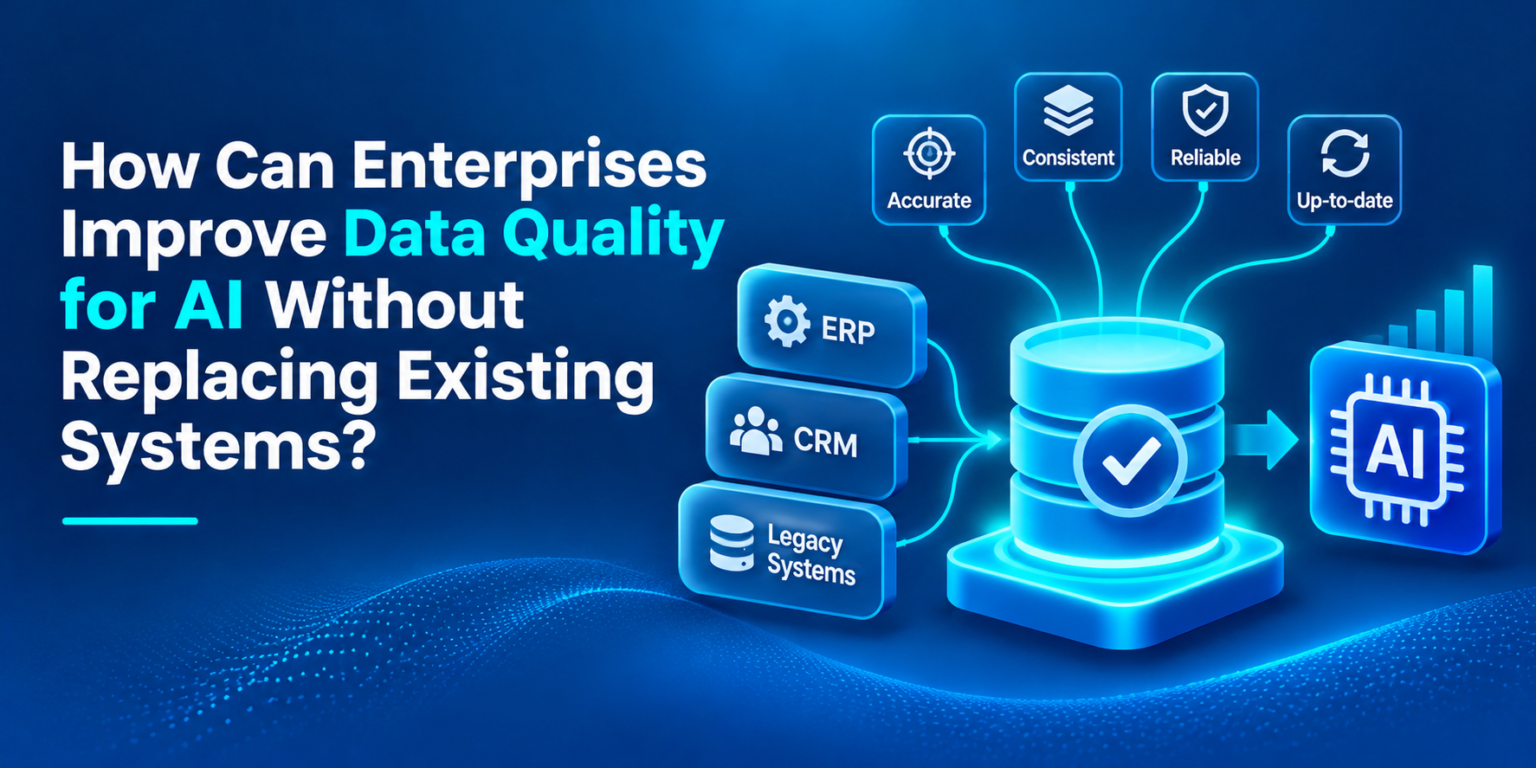
Why Does Data Quality Matter More as Enterprises Adopt AI?
Organizations have operated for years with inconsistent data, disconnected systems, and manual processes that compensate for gaps between them. Employees routinely reconcile conflicting information, correct errors, and make judgment calls that keep business operations moving.
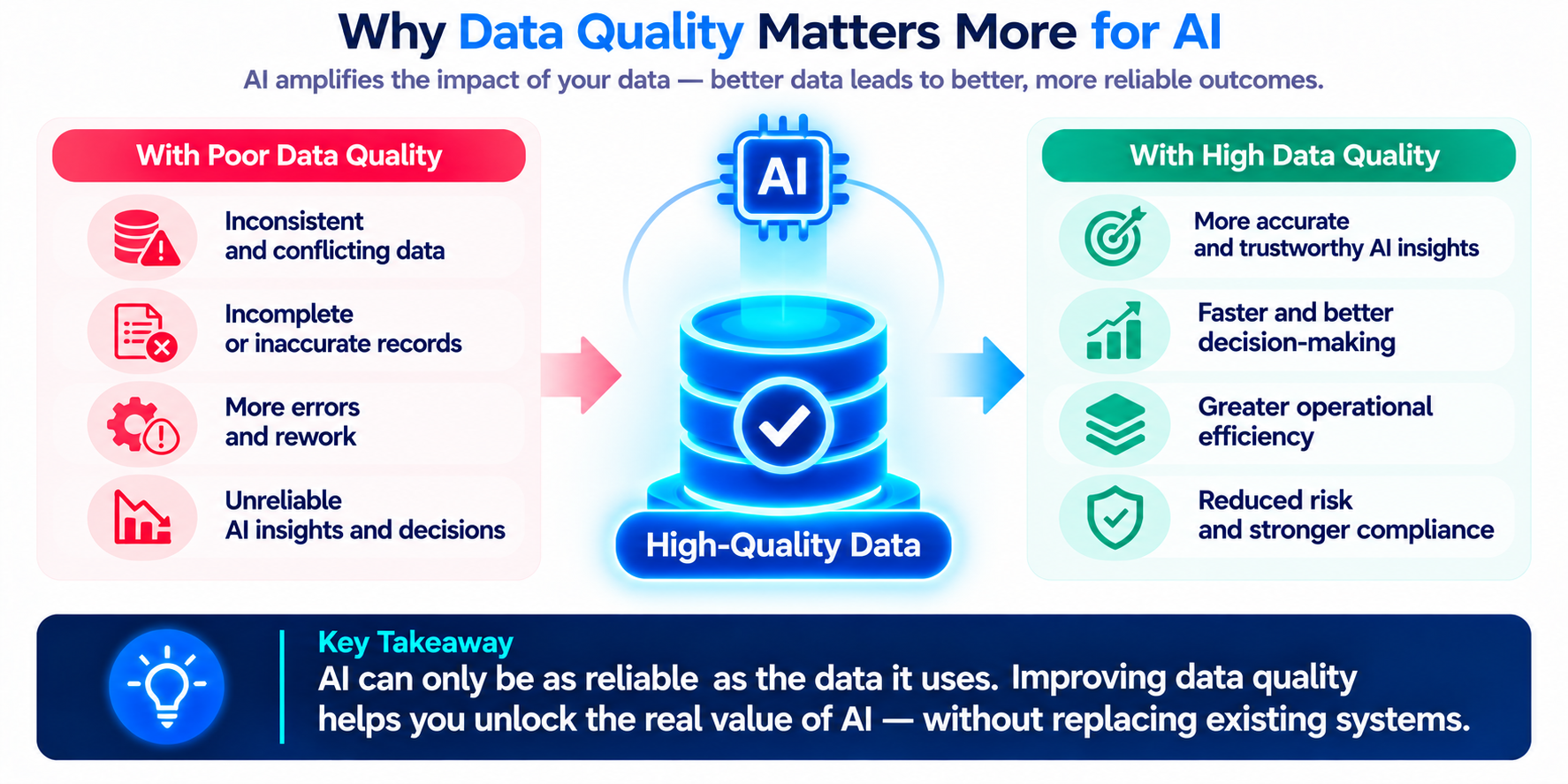
As enterprises introduce AI, these longstanding weaknesses become more consequential. When information is incomplete, inconsistent, or outdated, organizations risk accelerating errors rather than improving decisions.
The challenge is not necessarily a lack of data or inadequate technology. Often, it is the absence of consistent practices for validating, managing, and maintaining trusted information across existing systems.
For executives, the question becomes: How can we improve enterprise data quality without undertaking another costly, disruptive technology replacement?
The answer begins by understanding where data quality problems originate and how to address them at their source.
What Are the Most Common Enterprise Data Quality Problems?
Data quality problems rarely originate from a single system. More often, they develop as organizations expand, introduce new technologies, acquire businesses, and adapt processes without consistently addressing how information is managed.
Five recurring challenges deserve attention:
1. Inconsistent Data Across Systems
Customer, supplier, product, and operational information may be represented differently across ERP, CRM, and legacy applications. Without consistent definitions and controls, organizations struggle to establish which information is accurate and authoritative.
2. Inadequate Validation at the Source
Errors enter business processes when required information is missing, incorrect, or inconsistent. When validation occurs downstream, employees must correct problems that could have been prevented earlier.
3. Unclear Data Ownership and Accountability
When responsibility for data quality is fragmented or undefined, errors persist. Technology teams may manage the systems, but business functions must establish ownership of the information and processes they depend upon. Data Quality Governance Framework
4. Manual Reconciliation and Workarounds
Spreadsheets, duplicate data entry, and manual reconciliation compensate for disconnected systems or inconsistent processes. These workarounds keep operations moving but introduce additional opportunities for errors.
5. Inconsistent Processes Across Business Units
Differences in how teams capture, approve, update, and manage information produce inconsistent results, even when organizations use the same technology.
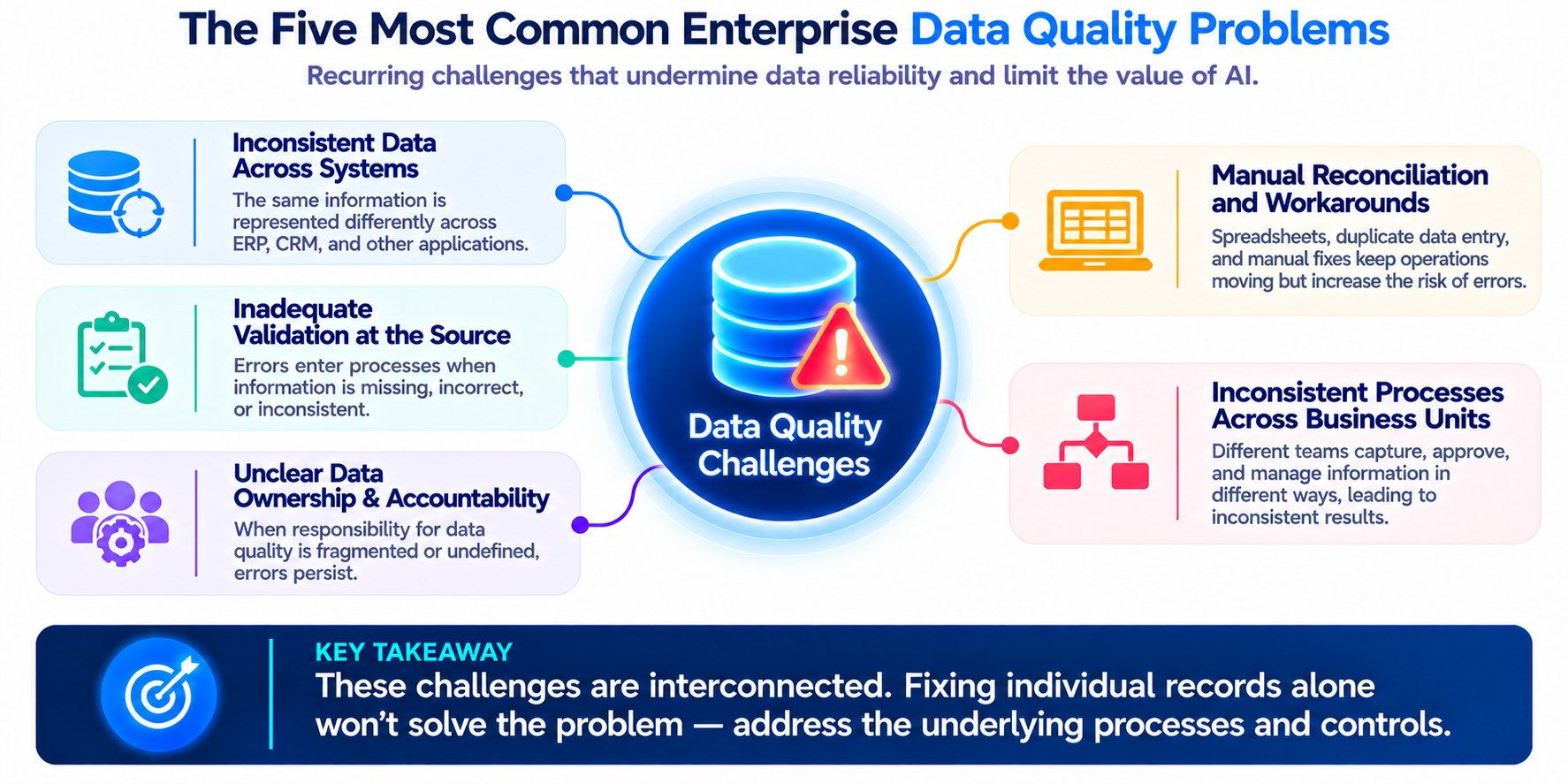
These challenges are interconnected. Correcting individual records without addressing the underlying processes and controls often allows the same problems to recur.
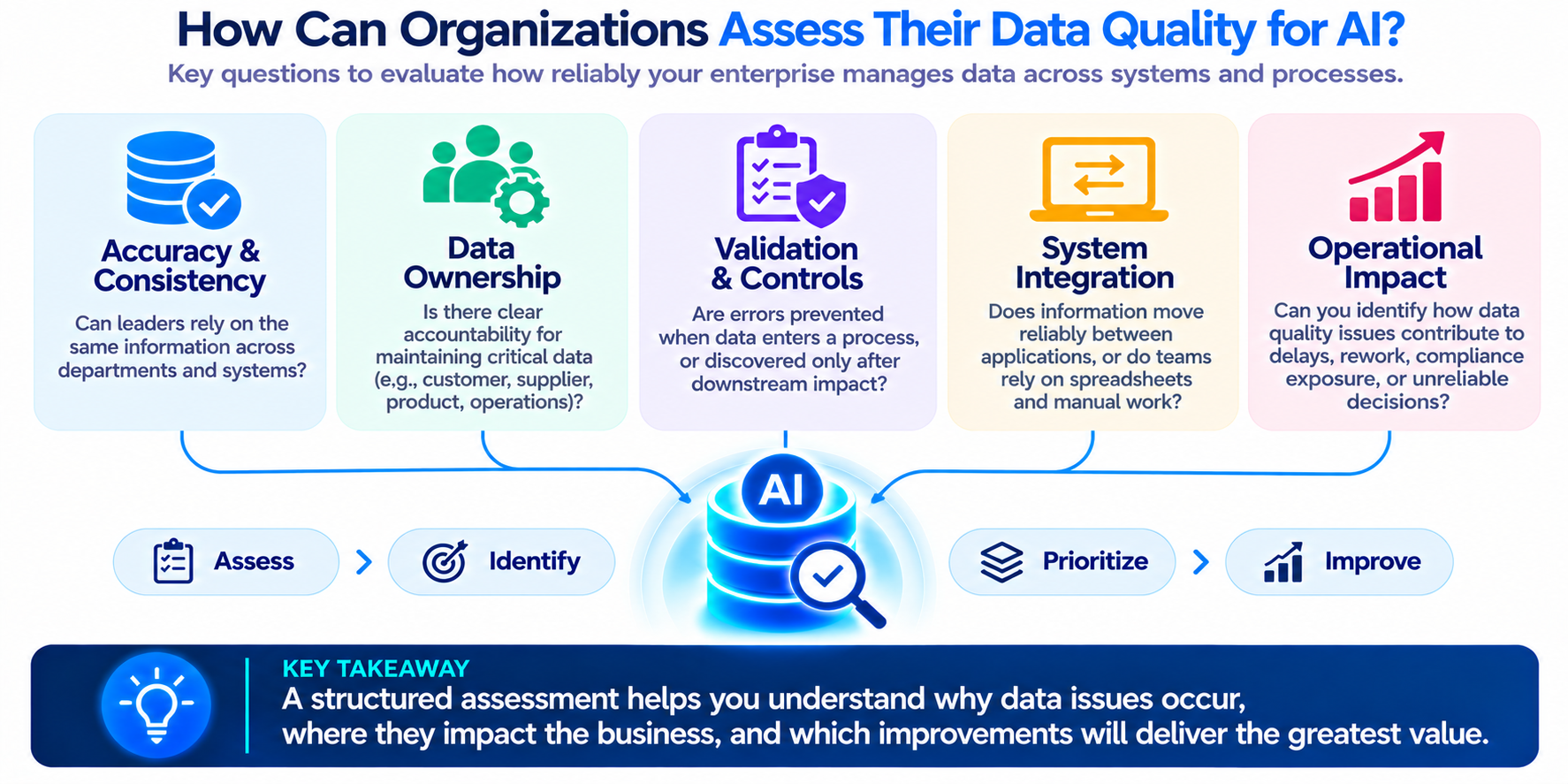
How Can Organizations Assess Their Data Quality for AI?
Before investing in new data platforms or AI applications, executives should understand how reliably their organization manages the information supporting critical business operations.
A practical data quality assessment should examine how information is created, validated, exchanged, and maintained across the enterprise.
Several questions can help identify where closer examination is necessary:
- Accuracy and Consistency: Can business leaders rely on the same information across departments and systems, or do conflicting records require reconciliation?
- Data Ownership: Is there clear accountability for maintaining critical customer, supplier, product, and operational data?
- Validation and Controls: Are errors prevented when information enters a process, or discovered after affecting downstream activities?
- System Integration: Does information move reliably between applications, or do employees depend on spreadsheets and manual intervention?
- Operational Impact: Can the organization identify how data quality problems contribute to delays, rework, compliance exposure, or unreliable decisions?
A structured assessment should also examine actual workflows, recurring exceptions, and the controls responsible for maintaining data quality.
For example, employees may routinely correct supplier information before purchase orders can be processed. The underlying issue may be inadequate validation during supplier onboarding rather than a limitation of the ERP system itself.
The objective is not simply to measure how much data is incorrect. It is to understand why errors occur, where they affect business performance, and which improvements will deliver the greatest value.
How Can Enterprises Improve Data Quality Without Replacing Existing Systems?
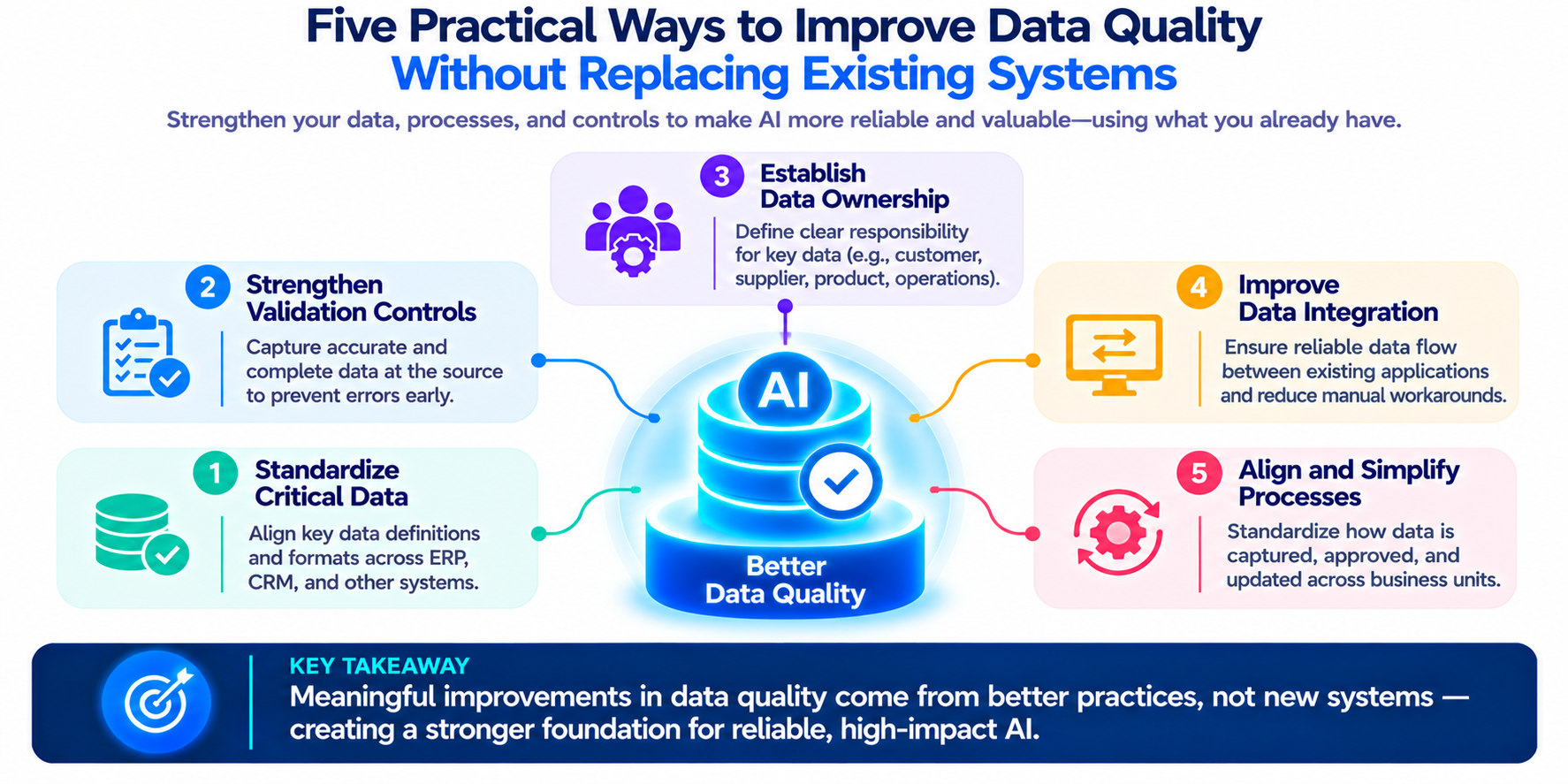
Improving enterprise data quality does not automatically require replacing ERP, CRM, or legacy applications. Often, the more effective starting point is strengthening the processes, controls, and integrations that determine how information moves through existing systems.
Five targeted improvements can make a meaningful difference:
1. Prevent Errors at the Source
Introduce consistent validation rules when customer, supplier, product, or transactional information is created or updated. Checking required fields, business rules, and supporting documentation before information enters downstream workflows reduces correction and rework.
2. Standardize Critical Workflows
Establish common procedures for capturing, reviewing, approving, and maintaining information. Necessary process variations should be intentional, documented, and governed rather than the result of inconsistent practices.
3. Establish Clear Data Ownership
Assign business accountability for critical data, including responsibility for resolving exceptions and maintaining quality standards. Technology enables controls, but operational leaders remain accountable for the information supporting their processes.
4. Reduce Manual Intervention Between Systems
Identify where employees repeatedly transfer, reconcile, or correct information between applications. Targeted integration and workflow automation can reduce these dependencies while allowing existing systems to continue performing their intended functions.
5. Introduce Governed Workflow Orchestration
When processes span multiple applications, an orchestration layer can coordinate validation, approvals, information exchange, and exception handling. This helps organizations reduce errors, eliminate unnecessary manual intervention, and enforce consistent business rules across existing systems without requiring wholesale technology replacement.
These improvements can be introduced incrementally, beginning with processes where unreliable data creates the greatest operational consequences.
The principle is straightforward: extend the value of existing technology before assuming it needs to be replaced.
How Does Better Data Quality Create a Foundation for Scalable AI?
Improving data quality creates business value before AI is introduced. Fewer errors, less manual reconciliation, more consistent workflows, and clearer accountability contribute directly to operational efficiency, reduced risk, and better decision-making.
These improvements also strengthen AI readiness. When applications depend on information from multiple systems, consistent validation, governance, and workflow execution provide a more reliable foundation for automated activities and decisions.
Importantly, organizations do not need to resolve every data challenge or replace every application before pursuing AI. They need to understand their most significant weaknesses, address critical dependencies, and establish controls that support reliable execution.
Soltec helps enterprises identify the operational weaknesses affecting data reliability and implement practical improvements that align people, processes, and technology. Through structured readiness assessments and governed workflow solutions, organizations can establish trusted data foundations while extending the value of existing technology investments.
The goal is not simply to prepare data for AI. It is to build more reliable, efficient, and adaptable enterprise operations.
Ready to improve data quality without replacing your existing systems?
Explore how Soltec can help identify critical weaknesses and establish a practical path toward trusted enterprise data.


Mark Kruckeberg is the Managing Partner of Soltec and a recognized leader in enterprise transformation, operational excellence, governance, and AI readiness. With more than 26 years of experience leading large-scale business, operational, and technology initiatives, Mark has helped organizations improve execution, strengthen governance, optimize workflows, and build trusted data foundations. Today, he works with enterprise leaders to improve operational performance, organizational readiness, and long-term business outcomes while preparing their organizations for successful AI adoption and future innovation.