Why Should Organizations Assess AI Readiness Before Scaling?
Organizations are investing in artificial intelligence with expectations of greater efficiency, improved decision-making, and measurable business value. Yet many are moving forward without fully understanding whether their existing operations can support those expectations.
AI doesn’t correct inconsistent workflows, unreliable data, unclear governance, or gaps in organizational capability. It operates within those conditions—and can amplify their consequences as adoption expands.
An AI Readiness Assessment helps executives identify these weaknesses before they become costly implementation challenges. Rather than focusing solely on technology, it evaluates the operational foundations necessary for AI to deliver reliable, sustainable outcomes.
More importantly, the assessment establishes where improvements should begin. Strengthening data quality, simplifying workflows, and clarifying governance can generate meaningful business value even before AI is deployed.
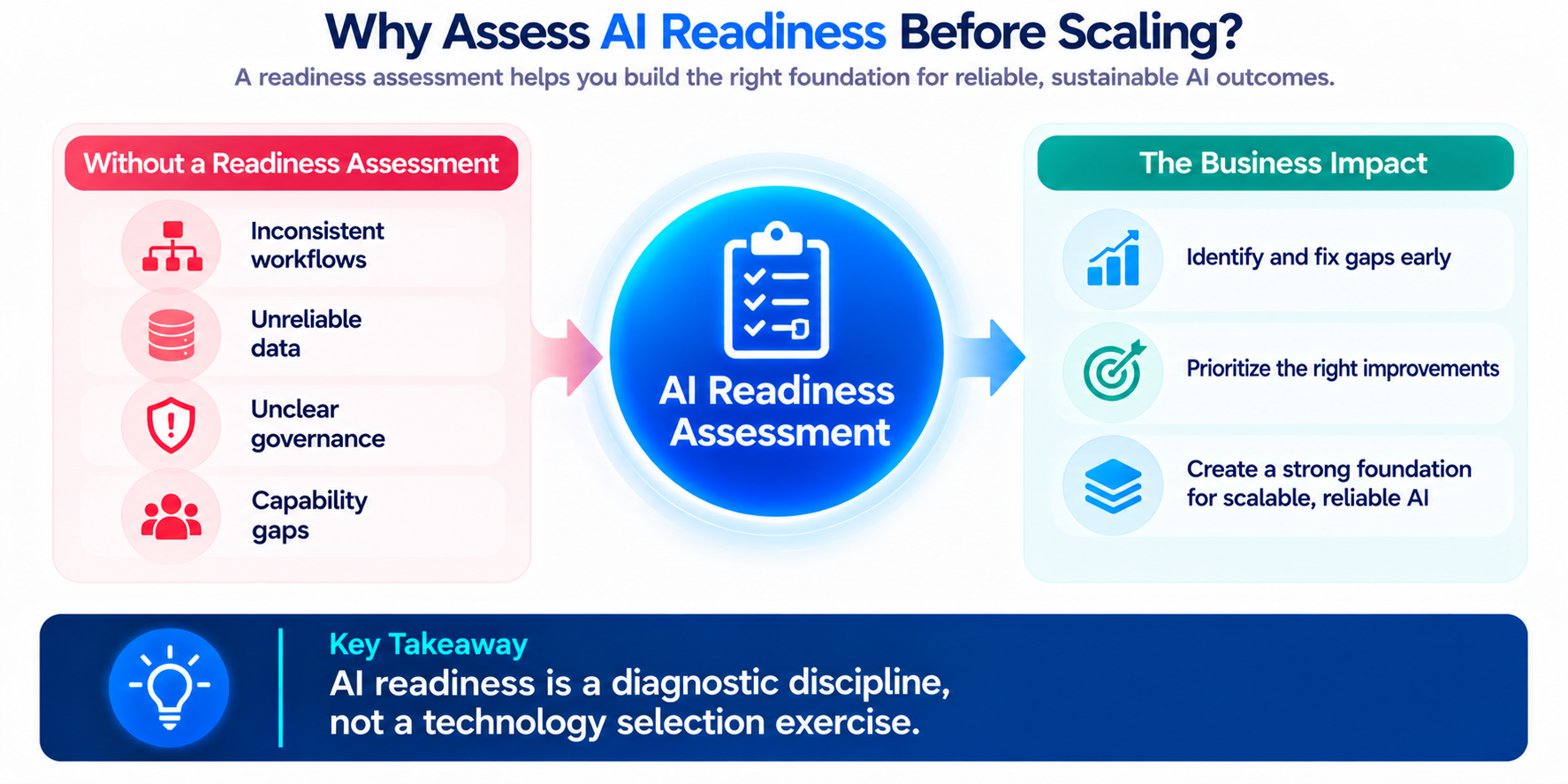
AI readiness is a diagnostic discipline, not a technology selection exercise.
What Six Areas Should Every AI Readiness Assessment Evaluate?
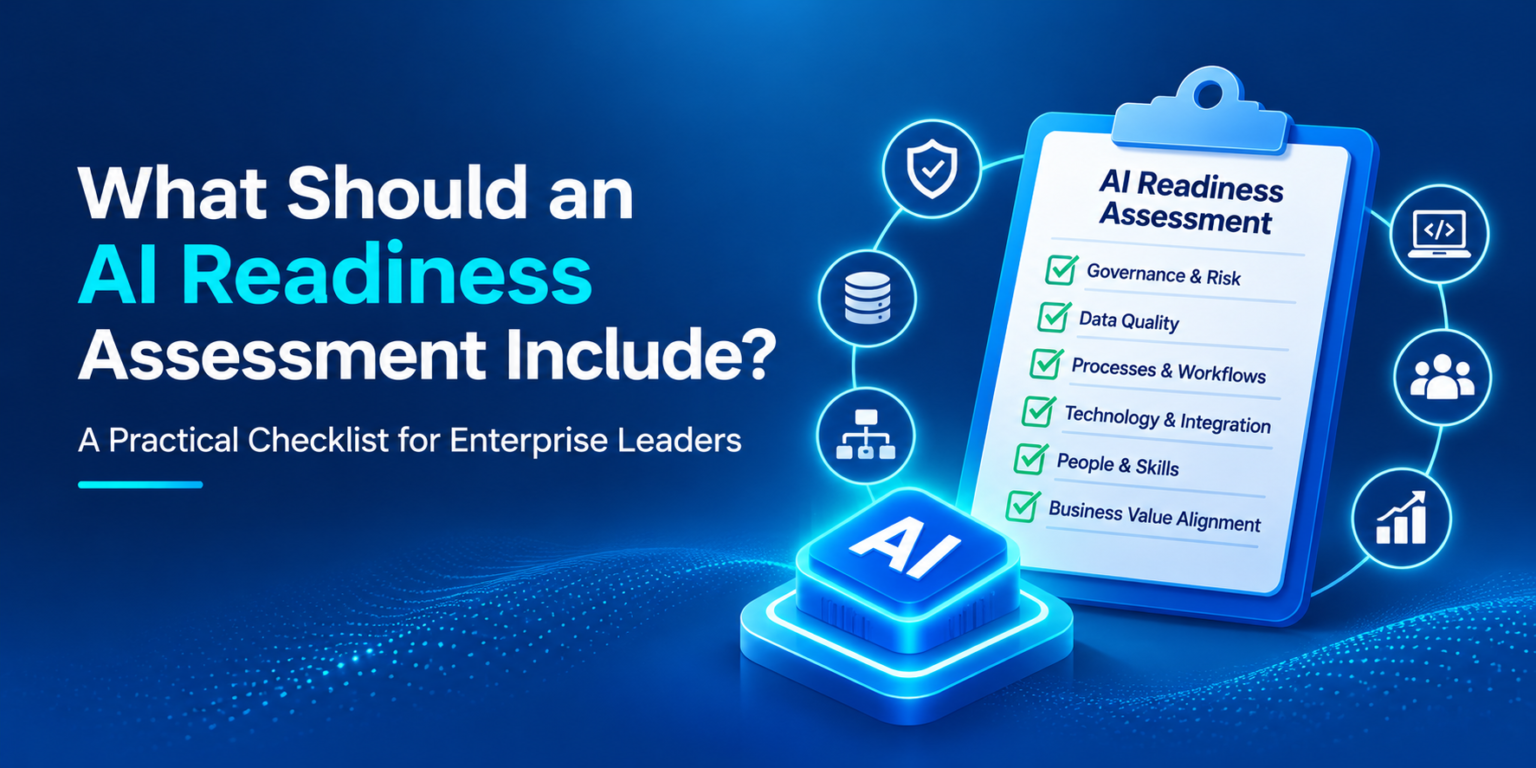
AI readiness extends well beyond technology. An effective assessment examines six interconnected areas that determine whether an organization can adopt, govern, and scale AI successfully.
1. Governance, Risk & Compliance
Are policies, accountability structures, risk controls, and oversight mechanisms established and consistently followed? Without clear governance, organizations risk introducing AI into environments where responsibilities, decisions, and controls are inconsistently defined or applied.
2. Data Quality
Is enterprise data accurate, complete, consistent, and trustworthy? AI depends on the information it receives. Poor data quality can undermine decisions, increase operational risk, and limit confidence in AI-generated outcomes.
3. Process & Workflow Readiness
Are business processes documented, understood, and executed consistently? AI can accelerate workflows, but it cannot independently resolve unnecessary complexity, undocumented exceptions, or inconsistent execution.
4. Technology & Integration
Can existing systems reliably exchange information and support AI-enabled workflows? Readiness requires understanding integration limitations, system dependencies, and whether the current technology environment can support scalable adoption.
5. People, Skills & Operating Model
Do employees and leaders have the skills, understanding, and organizational support necessary to adopt AI effectively? Even technically sound initiatives can struggle when roles, expectations, and change readiness are overlooked.
6. Business Strategy & Value Alignment
Are AI initiatives connected to clearly defined business priorities, measurable outcomes, and executive accountability? Readiness requires more than identifying potential applications; it requires understanding where AI can create meaningful value.
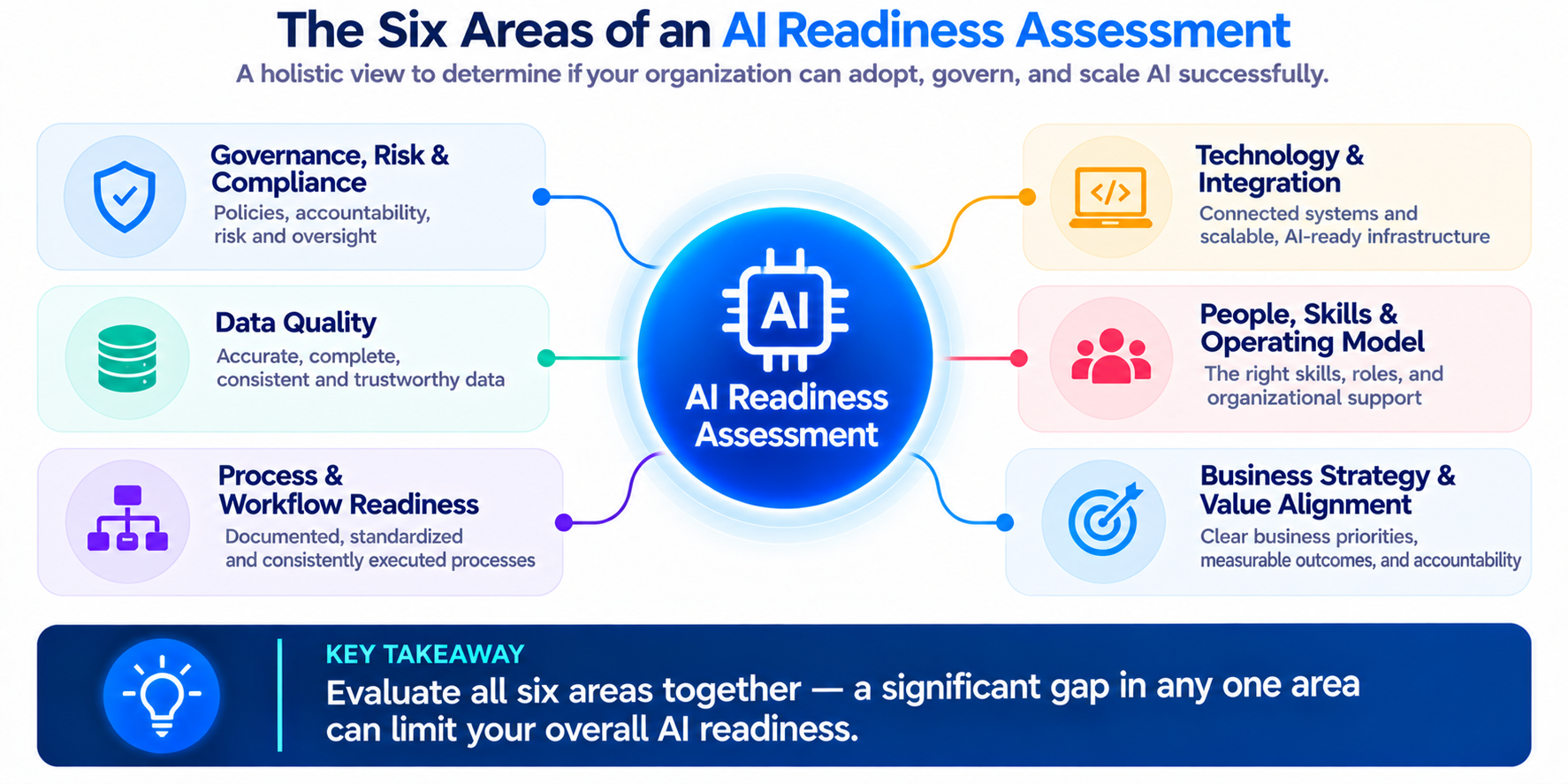
These six areas should be evaluated collectively. A significant weakness in any one area can limit the effectiveness of the others, regardless of an organization’s overall readiness.
Understanding these foundations is the starting point. The next step is recognizing how they may affect your own organization.
What Questions Should Be Included in an AI Readiness Checklist?
A practical AI readiness checklist helps executives look beyond technology and consider whether their organization has the foundations necessary to support successful AI adoption.
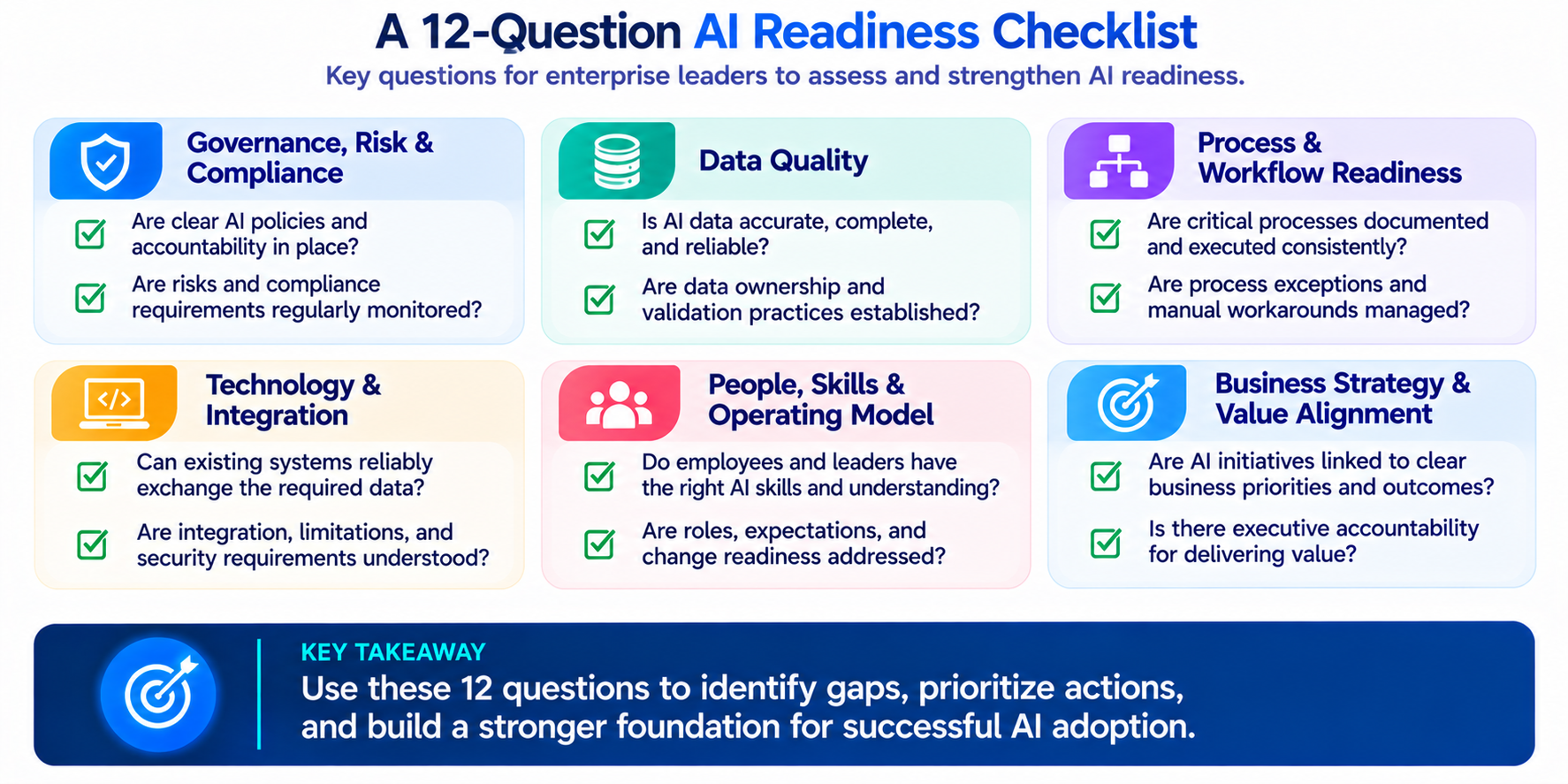
The following 12 questions are intended to encourage executive reflection and highlight areas that may warrant closer examination. They are not a substitute for a structured assessment, but they can help identify where deeper evaluation may be valuable.
Governance, Risk & Compliance
- Are clear policies, accountability structures, and oversight mechanisms established for AI-related decisions and activities?
- Are risks, regulatory requirements, and compliance obligations consistently evaluated and monitored across the organization?
Data Quality
- Is the data required for AI applications accurate, complete, consistent, and sufficiently reliable?
- Are data ownership, validation, and governance practices established to maintain data quality at its source?
Process & Workflow Readiness
- Are critical business processes documented, standardized where appropriate, and consistently executed?
- Are process exceptions, manual workarounds, and dependencies understood and actively managed?
Technology & Integration
- Can existing systems reliably exchange the information needed to support AI-enabled processes?
- Are technology limitations, integration dependencies, and security requirements understood before introducing AI solutions?
People, Skills & Operating Model
- Do employees and leaders understand how AI may affect their responsibilities, workflows, and decision-making?
- Are training, communication, and organizational change practices in place to support effective AI adoption?
Business Strategy & Value Alignment
- Are proposed AI initiatives aligned with clearly defined business priorities and measurable outcomes?
- Is there executive ownership and a structured approach for evaluating, prioritizing, and scaling AI opportunities?
Executives should consider where answers are clear and supported by established practices—and where they depend on assumptions, informal workarounds, or inconsistent execution.
Uncertainty in any area may signal the need for a more structured assessment.
The objective isn’t to answer every question perfectly. It’s to recognize where organizational readiness may be limiting the ability to achieve reliable, measurable AI outcomes.
How Should Organizations Identify and Prioritize AI Readiness Gaps?
Reviewing an AI readiness checklist is only the beginning. The real value comes from understanding what potential weaknesses reveal and determining which areas require closer attention.
Organizations should evaluate readiness across all six areas rather than relying on an overall impression. Strong technology capabilities, for example, do not compensate for unreliable data, inconsistent workflows, or inadequate governance.
Not every gap carries the same business risk or requires immediate action. Executives should prioritize findings based on three considerations:
- Business Impact: How significantly could the weakness affect operational performance, customer outcomes, or the expected value of AI initiatives?
- Risk and Exposure: Could the gap introduce compliance concerns, unreliable decisions, security vulnerabilities, or operational disruption?
- Dependencies: Does resolving the weakness establish a foundation needed for other improvements or AI initiatives to succeed?
For example, improving data validation at the point of entry may deserve greater priority than introducing another AI application that depends on the same unreliable information.
A structured assessment helps organizations move beyond initial observations by evaluating the severity, implications, and interdependencies of readiness gaps.
The objective is not simply to improve assessment scores. It is to identify the foundational improvements that reduce risk, strengthen enterprise operations, and create the conditions for AI to deliver measurable value.
How Do You Turn an AI Readiness Assessment Into an Actionable Roadmap?
An AI readiness assessment should lead to more than a list of findings. It should provide a clear path for addressing weaknesses, strengthening operational foundations, and preparing the organization for successful AI adoption.
A practical roadmap translates assessment results into prioritized actions, with defined ownership, measurable outcomes, and realistic timelines.
Organizations can begin with a focused 90-day improvement plan:
- Days 1–30 — Establish Priorities: Validate the most significant readiness gaps, confirm business impact, assign accountability, and identify improvements that can begin immediately.
- Days 31–60 — Address Foundational Weaknesses: Begin targeted improvements in areas such as data validation, workflow consistency, governance controls, or integration challenges.
- Days 61–90 — Measure Progress and Plan Ahead: Evaluate early results, address remaining dependencies, and establish the next phase of improvement and AI implementation priorities.
Not every readiness gap can be resolved in 90 days. The purpose is to establish momentum, demonstrate measurable progress, and create a disciplined approach to longer-term improvement.
Importantly, many of these actions can deliver immediate operational benefits. Better data quality, fewer manual workarounds, clearer accountability, and more consistent execution strengthen business performance regardless of when AI is deployed.
The value of becoming AI-ready does not have to wait for AI.
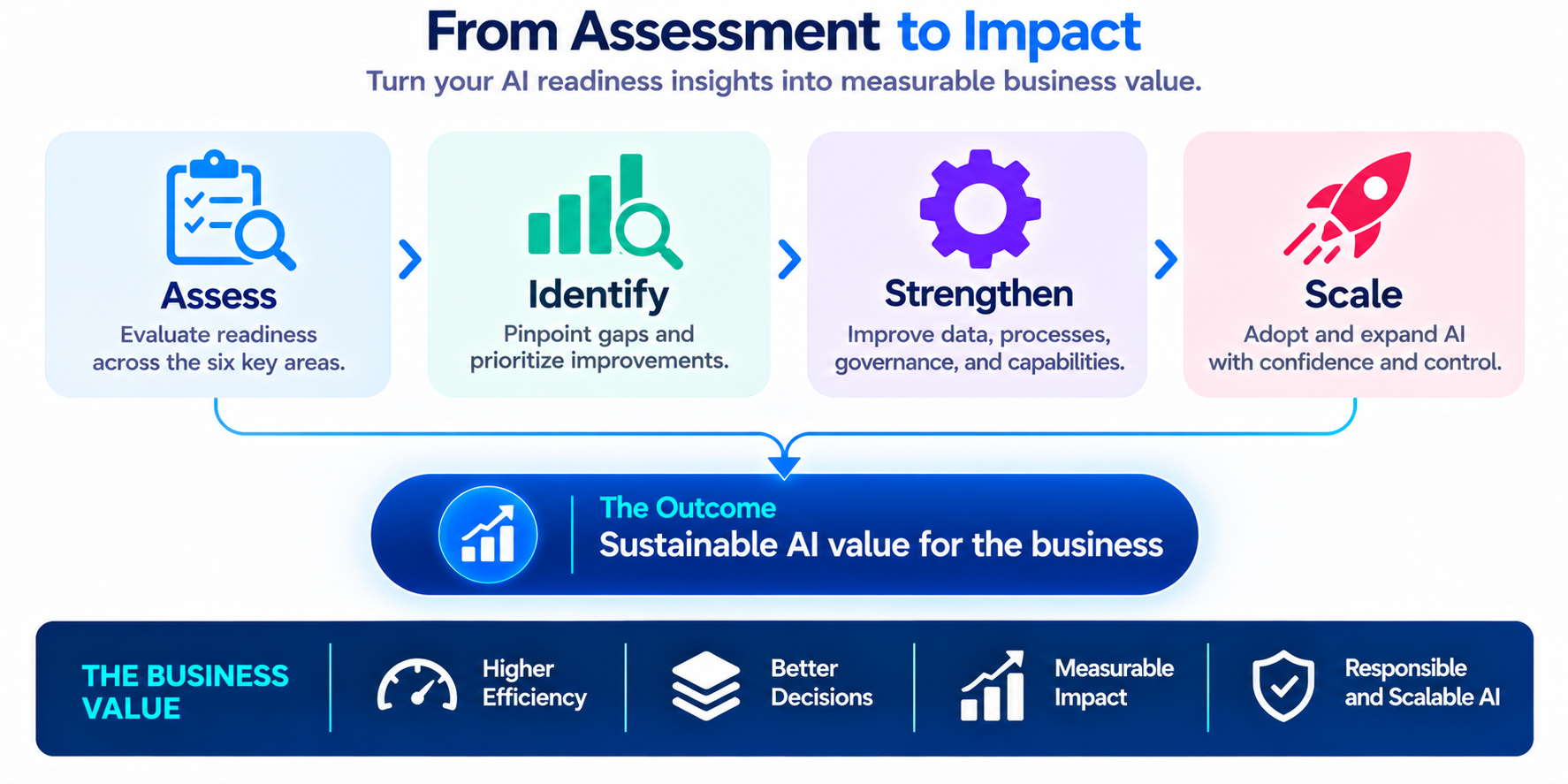
The roadmap should ultimately connect readiness improvements to business outcomes, ensuring that AI adoption builds on a stronger, more reliable operational foundation.
When Should an Organization Seek a Formal AI Readiness Assessment?
An initial checklist can help executives recognize potential weaknesses, but it may not reveal the full extent of organizational dependencies, operational risks, or improvements required to support AI adoption.
A more comprehensive AI Readiness Assessment becomes particularly valuable when organizations are preparing to scale AI initiatives, experiencing inconsistent results from early deployments, or struggling to determine which foundational improvements deserve priority.
It is equally relevant for organizations that have not yet implemented AI but want to establish a disciplined starting point.
Soltec’s AI Readiness Assessment evaluates six interconnected areas of enterprise readiness, helping organizations identify critical gaps, understand their business implications, and develop a prioritized roadmap for improvement.
The objective is not simply to determine whether an organization is ready for AI. It is to establish a clear, actionable path toward stronger operations, reduced risk, and measurable business value.
Ready to understand where your organization stands? Explore Soltec’s AI Readiness Assessment and identify the next steps toward successful AI adoption.


Mark Kruckeberg is the Managing Partner of Soltec and a recognized leader in enterprise transformation, operational excellence, governance, and AI readiness. With more than 26 years of experience leading large-scale business, operational, and technology initiatives, Mark has helped organizations improve execution, strengthen governance, optimize workflows, and build trusted data foundations. Today, he works with enterprise leaders to improve operational performance, organizational readiness, and long-term business outcomes while preparing their organizations for successful AI adoption and future innovation.