Why Is GRC Readiness Important for Manufacturers?
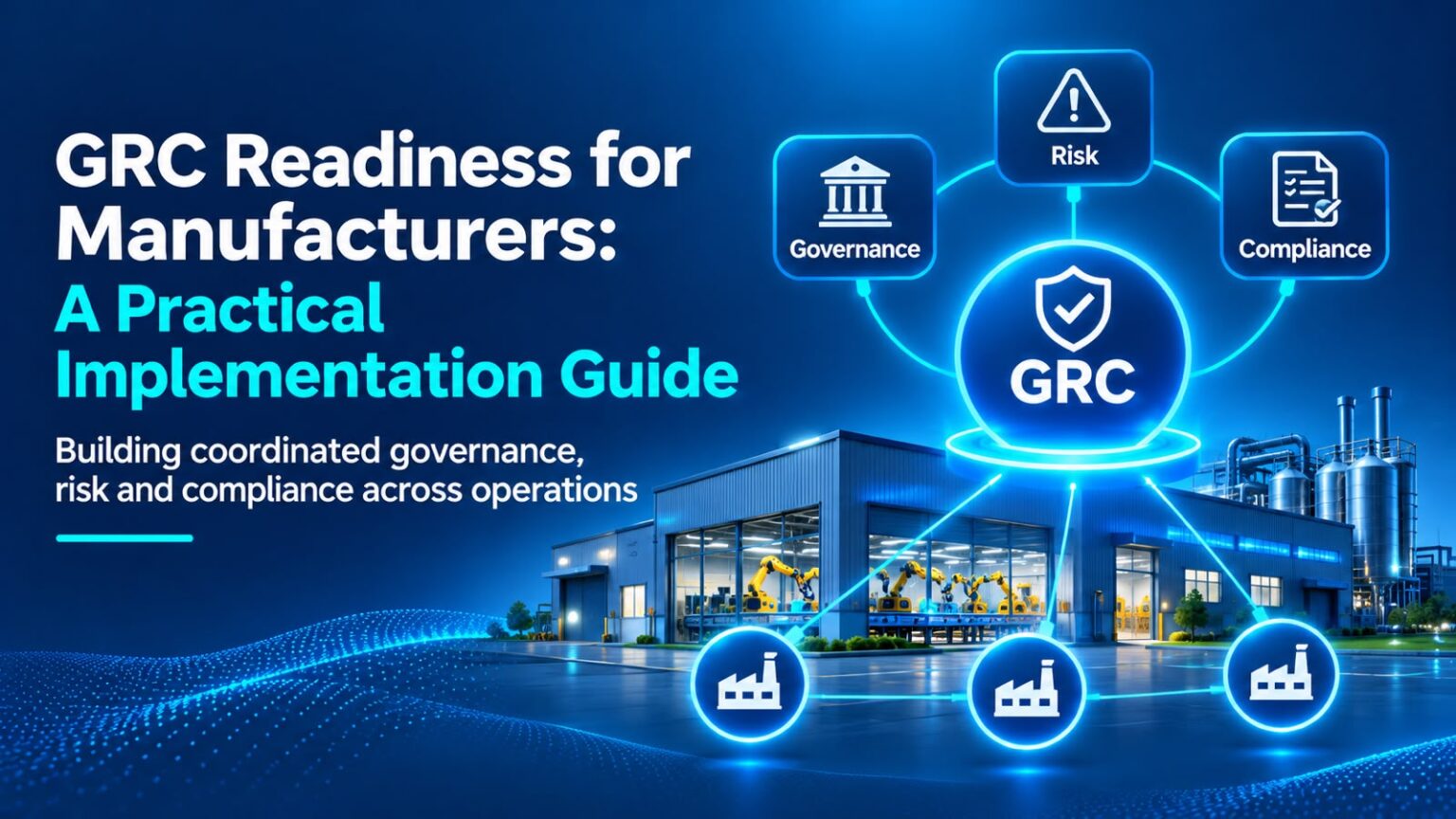
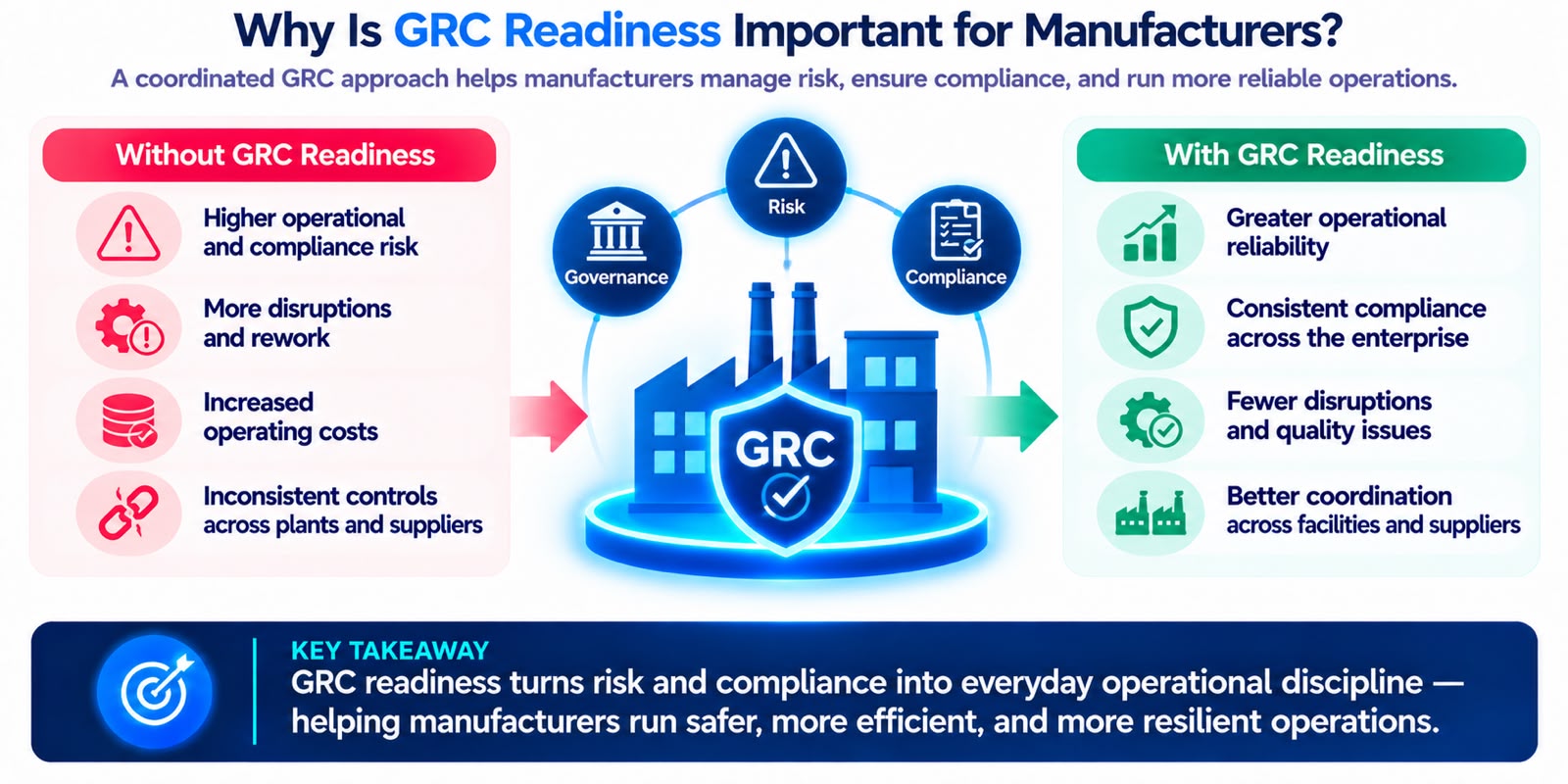
Manufacturers operate in environments where operational risks, regulatory obligations, cybersecurity threats, quality requirements, and supplier dependencies are increasingly interconnected. Yet governance, risk management, and compliance activities often remain fragmented across departments, facilities, and systems.
Individual functions may have established policies, controls, and reporting practices, but that does not necessarily mean risks are managed consistently across the enterprise. When accountability is unclear or information is disconnected, leadership can struggle to identify emerging exposures, coordinate responses, and maintain operational discipline.
The consequences extend beyond regulatory compliance. Inconsistent controls can contribute to production disruptions, quality failures, supplier issues, unnecessary rework, and increased operating costs.
GRC readiness is not simply about having policies in place or preparing for the next audit. It is about establishing the accountability, processes, controls, and visibility necessary to manage risk as part of everyday business operations.
For manufacturers, the opportunity is to move beyond reactive compliance activities toward a coordinated approach that strengthens operational reliability, reduces exposure, and supports more consistent execution across the enterprise.
What Are the Warning Signs of Poor GRC Readiness?
Manufacturers may have established compliance programs and risk management practices yet still lack consistent visibility and control across their operations. The challenge often becomes apparent when individual functions operate effectively on their own but struggle to coordinate across the enterprise.
Several warning signs deserve executive attention:
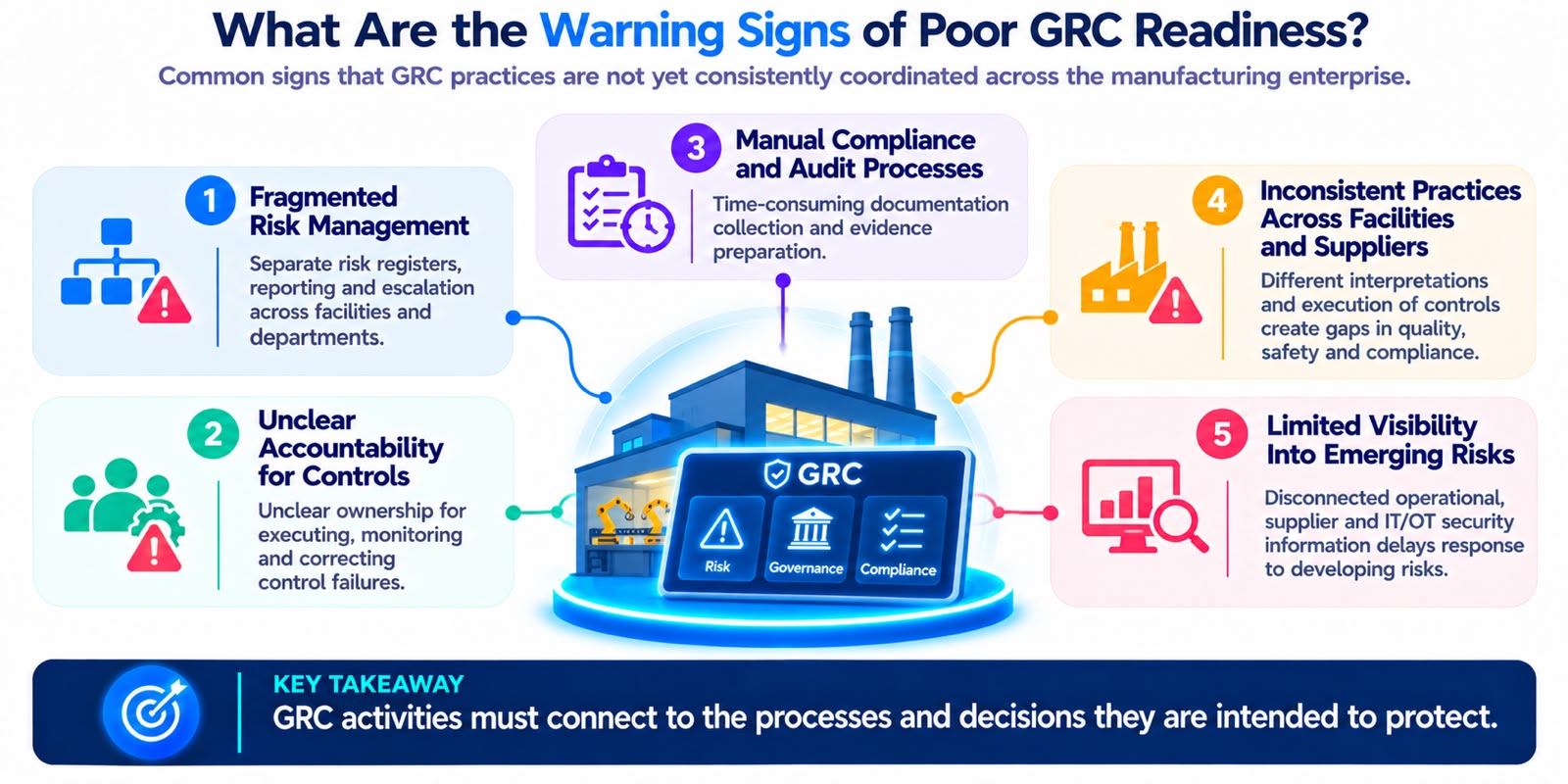
Fragmented Risk Management
Different facilities and departments maintain separate risk registers, reporting methods, and escalation procedures. Without a coordinated approach, leadership may struggle to understand enterprise-wide exposure or identify risks that affect multiple functions.
Unclear Accountability for Controls
Policies and procedures may exist, but responsibility for executing, monitoring, and correcting control failures is not always clearly assigned. This can allow weaknesses to persist until an audit, incident, or operational disruption exposes them.
Manual Compliance and Audit Processes
Employees spend significant time collecting documentation, reconciling information, and preparing evidence for audits. These activities may demonstrate compliance at a particular moment without providing ongoing assurance that controls are operating effectively.
Inconsistent Practices Across Facilities and Suppliers
Differences in how plants, business units, and suppliers interpret requirements or execute controls can create gaps in quality, safety, cybersecurity, and regulatory compliance.
Limited Visibility Into Emerging Risks
When operational, supplier, and IT/OT security information remains disconnected, leadership may not recognize developing issues early enough to prevent disruption or coordinate an effective response.
These warning signs often share a common cause: governance and compliance activities exist, but they are not consistently connected to the processes and decisions they are intended to protect.
Recognizing these weaknesses is the first step toward evaluating whether the organization’s GRC practices are sufficiently coordinated, repeatable, and effective.
How Can Manufacturers Assess Their GRC Readiness?
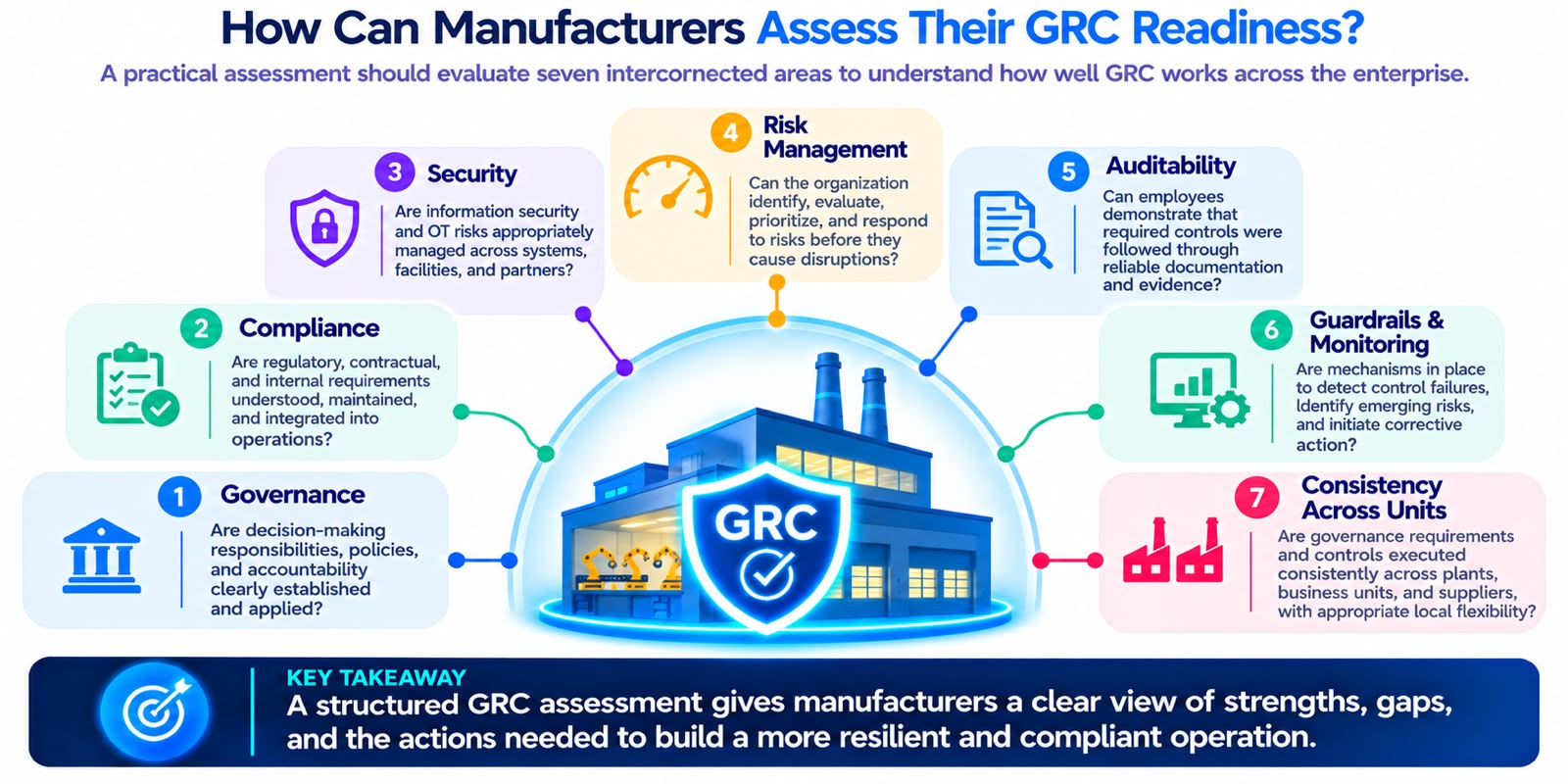
Assessing GRC readiness requires more than reviewing policies, audit findings, or compliance documentation. Manufacturers need to understand whether governance practices and risk controls are consistently applied across facilities, functions, systems, and suppliers.
A practical assessment should examine seven interconnected areas:
- Governance: Are decision-making responsibilities, policies, and accountability structures clearly established and consistently applied across the organization?
- Compliance: Are regulatory, contractual, and internal requirements understood, maintained, and integrated into daily operations?
- Security: Are information security and operational technology risks appropriately managed across systems, facilities, and external partners?
- Risk Management: Can the organization identify, evaluate, prioritize, and respond to operational and enterprise risks before they become significant disruptions?
- Auditability: Can employees demonstrate that required controls were followed through reliable documentation, traceable decisions, and accessible evidence?
- Guardrails & Monitoring: Are mechanisms in place to detect control failures, identify emerging risks, and initiate corrective action?
- Consistency Across Units: Are governance requirements and controls executed consistently across plants, business units, and suppliers, with appropriate allowances for local requirements?
These illustrative questions highlight the areas manufacturers should examine, rather than serving as a complete assessment. A structured GRC Readiness Assessment goes further by evaluating how controls actually operate, where exceptions occur, and whether identified weaknesses are addressed consistently.
The objective is not simply to determine whether controls exist. It is to understand whether they work reliably, where exposure remains, and which improvements deserve priority.
This creates the foundation for a practical improvement plan that strengthens governance without introducing unnecessary operational complexity.
How Can Manufacturers Improve GRC Without Adding Operational Complexity?
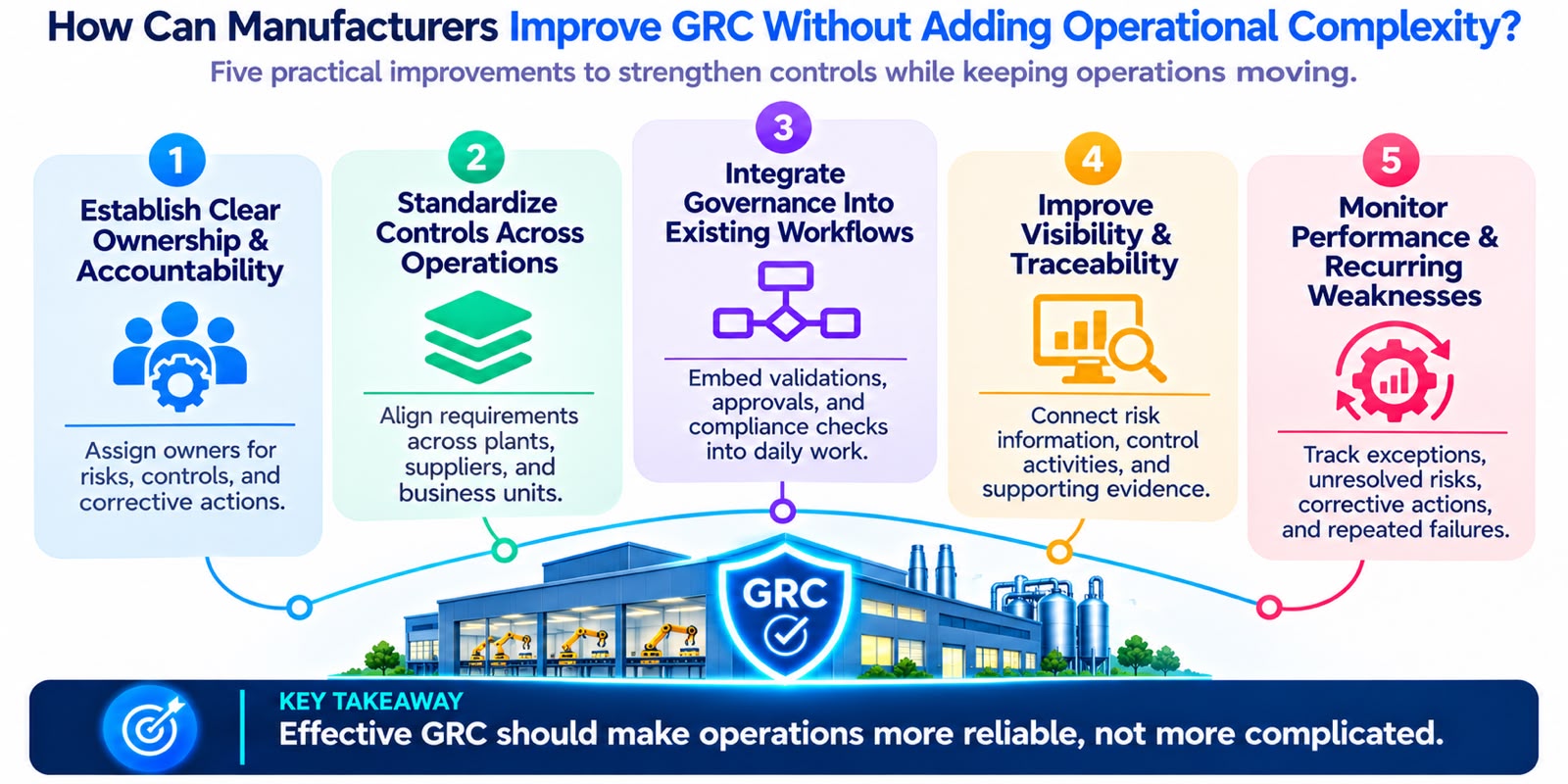
Improving GRC readiness does not necessarily require new systems, additional layers of approval, or more administrative work. The priority should be strengthening existing processes and controls while reducing the fragmentation that makes governance difficult to manage.
Manufacturers can begin with five practical improvements:
Establish Clear Ownership and Accountability
Assign responsibility for critical risks, controls, and corrective actions. Business leaders should understand what they own, how issues are escalated, and who is accountable for resolving weaknesses across functions and facilities.
Standardize Controls Across Operations
Establish consistent requirements for activities such as supplier onboarding, quality management, maintenance, and regulatory compliance. For example, a supplier approved at one facility may not meet the documentation requirements of another. Standardized controls can make these differences visible while reducing duplicated administrative effort.
Integrate Governance Into Existing Workflows
Embed required validations, approvals, and compliance checks into everyday business processes rather than relying on separate reviews or manual follow-up. This helps prevent control failures before they create downstream consequences.
Improve Visibility and Traceability
Connect relevant risk information, control activities, and supporting evidence so leadership can identify emerging issues and understand whether required procedures are being followed. Reliable audit trails also reduce the effort required to demonstrate compliance.
Monitor Performance and Address Recurring Weaknesses
Track control exceptions, unresolved risks, corrective actions, and recurring failures. Use these insights to prioritize improvements and verify that changes are producing measurable results.
These improvements should begin where fragmented governance creates the greatest operational exposure. A targeted approach allows manufacturers to strengthen controls incrementally without disrupting established operations.
Effective GRC should make operations more reliable, not more complicated. When governance becomes part of normal workflow execution, organizations can improve accountability, reduce unnecessary administrative effort, and respond more consistently to risk.
How Does Stronger GRC Readiness Improve Manufacturing Performance?
Stronger GRC readiness delivers value beyond regulatory compliance. When accountability is clear, controls are consistently executed, and risks are visible across the enterprise, manufacturers are better positioned to prevent disruptions, reduce rework, and make informed operational decisions.
A coordinated approach enables leadership to identify weaknesses earlier, address recurring control failures, and improve consistency across facilities and suppliers. It also establishes governance foundations that can support emerging technologies, including AI, without introducing unmanaged risks.
GRC readiness is not about eliminating every risk or adding more controls. It is about ensuring the right controls are consistently applied, monitored, and improved where they matter most.
Soltec helps manufacturers evaluate governance, risk, and compliance maturity through a structured GRC Readiness Assessment. By identifying gaps in accountability, control effectiveness, auditability, and operational consistency, organizations can establish a prioritized roadmap for improvement.
The objective is to make governance a practical part of enterprise execution—strengthening operational reliability while reducing unnecessary complexity.
Ready to strengthen governance across your manufacturing operations? Explore Soltec’s GRC Readiness Assessment to identify critical gaps and establish a practical path forward.


Mark Kruckeberg is the Managing Partner of Soltec and a recognized leader in enterprise transformation, operational excellence, governance, and AI readiness. With more than 26 years of experience leading large-scale business, operational, and technology initiatives, Mark has helped organizations improve execution, strengthen governance, optimize workflows, and build trusted data foundations. Today, he works with enterprise leaders to improve operational performance, organizational readiness, and long-term business outcomes while preparing their organizations for successful AI adoption and future innovation.